Under Oath with Crossed Fingers
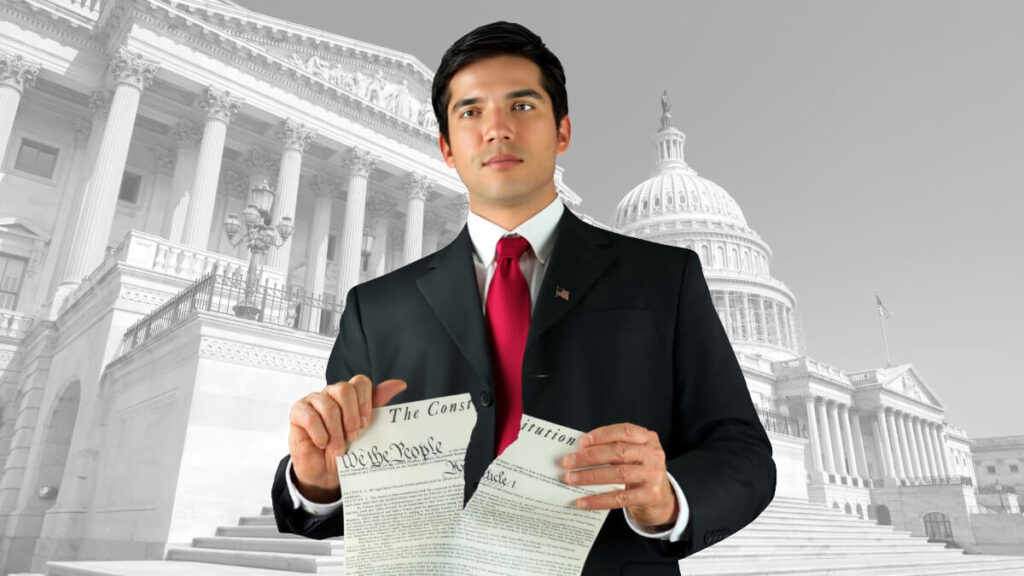
Here’s an old joke that may not be a joke anymore: Did you hear that all newly elected politicians have to take an updated oath of office?
It’s now called the Hypocritic Oath . . .
This old joke may become a reality soon. Several Democratic Socialists of America (DSA) members have won primaries for the November 2026 midterm elections, and several of them in deep-blue districts are almost certain to be elected to Congress. If these Democratic Socialists are elected, they will be required to pledge allegiance to and vow to support and defend the Constitution of the United States. The problem lies in their party platform, which calls for relegating the Constitution to the scrap heap of history.
Nicholas Giordano, writing in The Federalist, asks the crucial question, “Today, Americans face an unprecedented constitutional question. What happens when candidates for public office belong to an organization that rejects the constitutional order? If elected, how can these individuals honestly swear a sacred oath to support and defend the Constitution when their own organization calls for its replacement?”
The Constitution makes clear in Article VI that all Senators and Representatives (as well as state legislators and federal and state executive and judicial officers) “shall be bound by Oath or Affirmation, to support this Constitution.”
According to the History of the House of Representatives, “Oaths of office and allegiance have been features of government for centuries. When the United States were colonies of Great Britain, officials swore allegiance to the king. Colonial and state legislatures also created oaths that required members to swear allegiance to the state and often profess a belief in God as well. Today, Members of the House take an oath to uphold the Constitution in a group swearing-in on the House Floor on the opening day of a new Congress.”
The current oath has not changed since 1966. It reads, “I do solemnly swear (or affirm) that I will support and defend the Constitution of the United States against all enemies, foreign and domestic; that I will bear true faith and allegiance to the same; that I take this obligation freely, without any mental reservation or purpose of evasion; and that I will well and faithfully discharge the duties of the office on which I am about to enter. So help me God.”
Can avowed Democratic Socialists honestly and without “purpose of evasion” pledge their allegiance to the Constitution? Does their platform “support and defend” our founding document or intend to destroy its very nature?
The DSA Platform is full of shocking and downright wacky provisions such as abolishing the police and prisons, providing free reproductive (abortion) and gender-affirming (genital mutilation) care for all, defunding the Department of War and eliminating the functions of Immigration and Customs Enforcement, giving mass amnesty for all illegals, and ending visa caps and quotas. While these ideas are crazy, they are not necessarily unconstitutional. What is most troubling, and should prevent its adherents from honestly taking the oath of office, are their calls to:
- Replace the President and Supreme Court with an executive and judiciary chosen by and subordinate to Congress
- Expand the House of Representatives and abolish the Senate
- Abolish the Electoral College
Many members of Congress have proposed amendments to the Constitution, but there is a big difference between reform and replacement. What the DSA platform proposes is not mere amendments to that order but an overturning of the very structure of the federal government and replacing it with a new framework. Eliminating the separation of powers and the vital checks and balances would be undemocratic and lead us into tyranny. These planks in the DSA platform would do just that.
The Constitution organizes our federal government in a system made up of three branches. The legislative branch (Article I) that spells out how Members are elected, their terms, their powers, and their jurisdiction for lawmaking. Article II sets up the executive branch, independent from the legislature but tasked with enforcing the laws that are passed by both Houses of Congress and signed by the President. The Judicial branch (Article III) is to consist of a Supreme Court and any inferior courts that Congress deems necessary. This separation of powers can be likened, albeit crudely, to the children’s game of “rock, paper, scissors” because while each branch has unique functions, they are each restrained by the “checks and balances” on their powers. The drafters did not want to repeat the monarchical system in which the King reigned supreme, nor did they want to vest all power in the legislature or judiciary.
Justice Antonin Scalia explained that what makes the United States unique is not our great Bill of Rights, but the separation of powers. While testifying before Congress in October 2011, Scalia said:
So the real key to the distinctiveness of America is in the structure of our government. One part of it, of course, is the independence of the judiciary. But there’s a lot more. There are very few countries in the world, for example, that have a bicameral legislature. . . Very few countries have two separate bodies in the legislature equally powerful. Very few countries in the world have a separately elected chief executive. . . the Europeans don’t even try to divide the . . two political branches, the legislature and the chief executive. In all of the parliamentary countries the chief executive is the creature of the legislature. There’s never any disagreement between them and the prime minister . . . When there’s a disagreement they just kick him out. They have a no confidence vote, a new election, and they get a prime minister who agrees with the legislature.
The DSA’s call to eliminate the bicameral legislature, to destroy the independent executive and judicial branches and to make them subordinate to an expanded House would not reform our system but thoroughly obliterate it. They are proposing to throw out the key elements of Articles I, II, and III of our Constitution.
Merrill Matthews, the Texas state chair of Our Republican Legacy, wrote in The Hill, “I submit that any political candidate who supports essentially canceling the first three Articles in the Constitution cannot truthfully say he or she will support and defend the Constitution. To take the oath would be to commit perjury.”
Nicholas Giordano also asks, “Is the constitutional oath a meaningful safeguard or is it nothing more than hollow words? If the constitutional oath means anything, anyone who belongs to and advocates for an organization that seeks to replace the Constitution should never assume office.”
Under our Constitution, Article I, Section 5, “Each House shall be the Judge of the Elections, Returns and Qualifications of its own Members.” In practice, as soon as a state certifies the congressional election and the Clerk receives credentials, the winner is a Member-elect with the right to be sworn in. Both the House and Senate do have the power to exclude newly elected members by a majority vote, but it seems extremely unlikely they would do so. Whether or not the Democrats regain the majority, they will not refuse to seat DSA members who will caucus with them.
The job of Americans across this nation, then, is to educate our fellow citizens about the dangerous and destructive DSA platform, and the threat to our very system of government. We must hold their feet to the fire. We must expose and reject those who cannot honestly pledge to support and defend the greatest Constitution in the history of mankind.
Share this:
- Share on Facebook (Opens in new window) Facebook
- Share on X (Opens in new window) X
- Share on LinkedIn (Opens in new window) LinkedIn
- More
- Share on WhatsApp (Opens in new window) WhatsApp
- Share on Telegram (Opens in new window) Telegram
- Share on Reddit (Opens in new window) Reddit
- Email a link to a friend (Opens in new window) Email
- Share on Pinterest (Opens in new window) Pinterest
- Share on Tumblr (Opens in new window) Tumblr
- Print (Opens in new window) Print