Electoral College Coup
After their nationwide victories last week in the midterm elections, Democrats are plotting to wield their majorities to fundamentally change the fabric of our nation. Not only did Democrats flip control of the U.S. House of Representatives and Senate, but they made historic gains in state legislatures and governors’ offices. The party is poised to enter 2027 with control of 23 state legislatures and as many as 30 governorships. These gains mark a dramatic shift in the political landscape and allow leftists to pursue sweeping changes to laws and policies across the country.
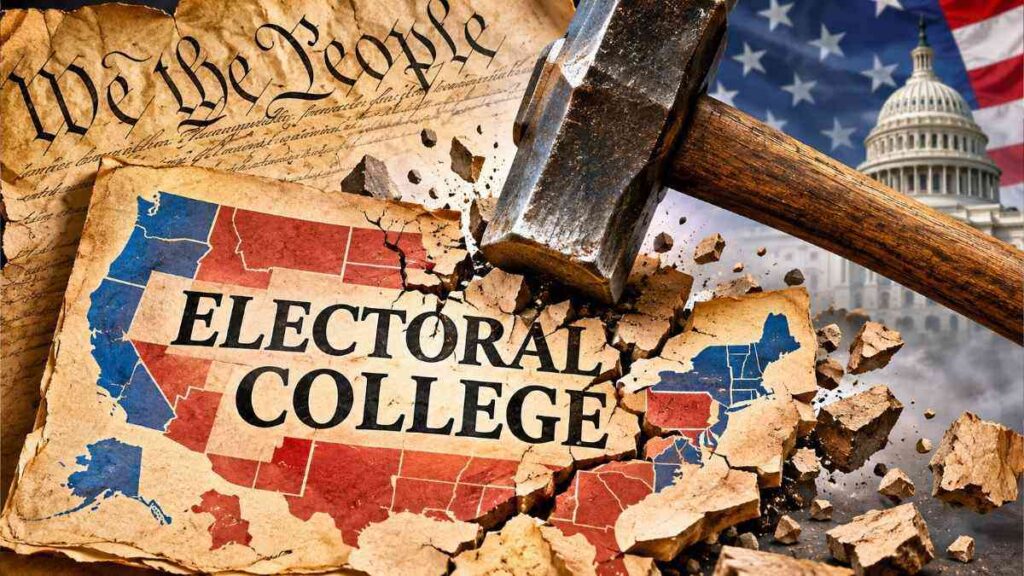
One of the objectives of both the Democratic Socialists of America and so-called “mainstream” Democrats is dismantling the Electoral College. They apparently detest the fact that we will live in a republic, not a democracy. Rather than pursuing a constitutional amendment, which would take years (and likely billions of dollars) to get ratified, Democrats are pushing the National Popular Vote Interstate Compact (NPVIC) to effectively bypass the traditional state-by-state electoral process. With their newly expanded control of state governments, they see this as a more viable option.
The Electoral College was created by our Founding Fathers as part of the U.S. Constitution. Under this system, each state receives electoral votes equal to its total representation in Congress: the number of U.S. Representatives plus its 2 U.S. Senators. Regardless of population, every state receives a minimum of 3 electoral votes. A candidate must secure a majority of the 538 electoral votes — at least 270 — to win the presidency.
This arrangement was intentional. The Founders understood that a national popular vote could allow heavily populated regions to dominate presidential elections while leaving smaller states and their interests increasingly marginalized. The Electoral College recognizes that America is a union of individual states, not simply one enormous voting bloc. It requires presidential candidates to build diverse coalitions rather than concentrating their campaigns exclusively in the nation’s largest population centers. The Founders warned against “tyranny of the majority.”
Consider the difference between California and Mississippi. California has approximately 39.5 million residents, while Mississippi has approximately 3 million. California’s population is more than thirteen times larger. Under a strictly national popular vote, California’s voters would collectively carry substantially more weight than Mississippi’s voters. The state of California tends to elect more liberals to state and federal offices, whereas Mississippi does the opposite. The Electoral College, however, ensures that Mississippi retains a meaningful voice in selecting the nation’s president, rather than allowing the largest populated states to determine the outcome. As Eagle Forum founder Phyllis Schlafly explained:
People who pretend that the Electoral College system is undemocratic are not only ignorant of the history and purposes of the U.S. Constitution, but they probably don’t even understand baseball. Basing the election on a plurality of the popular vote while ignoring the states would be like the New York Yankees claiming they won the 1960 World Series because they outscored the Pirates in runs 55-27 and in hits 91-60. Yet, the Pirates fairly won that World Series, 4 games to 3, and no one challenges their victory.
It also protects against the concentration of political power in a handful of densely populated areas. Without the Electoral College, candidates could have even greater incentive to campaign exclusively in major metropolitan areas while neglecting rural communities, smaller states, and regions with different economic and political priorities. The interests of Americans outside those heavily populated areas could be ignored.
The election of Abraham Lincoln in 1860 is a great example. In a four-way presidential contest, Lincoln won approximately 39.8% of the popular vote yet secured an Electoral College victory. Although he did not receive a majority of the popular vote, he won the electoral votes for the presidency. His election demonstrates that the Electoral College is not simply a mechanism for determining which candidate receives the most individual votes; it is a system designed to produce a national governing mandate through the states.
If Democrats replace this system, the political consequences could be enormous. Throughout American history, 5 presidential elections have resulted in a candidate winning the Electoral College while losing the national popular vote: 1824, 1876, 1888, 2000, and 2016. Four of those victories went to Republican candidates, including George W. Bush in 2000 and Donald Trump in 2016. In both modern elections, Democrats won the national popular vote but lost the presidency under the constitutional system currently in place.
The National Popular Vote Interstate Compact, if agreed to by enough states, would technically eliminate the Electoral College framework without formally amending the Constitution. The compact is an agreement among participating states that they award all their electoral votes to the winner of the national popular vote, regardless of which candidate actually wins those individual states. For example, if Virginia voters cast more ballots for Candidate A, but Candidate B won the popular vote tally nationwide, Virginia’s electors would vote for Candidate B when the Electoral College meets. This means the preference of Virginians for Candidate A would be ignored.
Those who seek to get rid of the Electoral College now have a renewed opportunity to advance the National Popular Vote Interstate Compact. As of November 2026, 18 states and Washington, D.C., have enacted legislation joining the compact, including Virginia, which joined earlier this year. Together, these jurisdictions control 222 electoral votes. The Compact says that it will go into effect once adopters total 270 electoral votes. This means they only need an additional 48 electoral votes to trigger its activation.
The recent election results have brought several additional states into play. Pennsylvania and Wisconsin are particularly significant because Democrats now have unified control of their state governments. If both states joined the compact, they would add another 29 electoral votes, bringing the total to 251. From there, adding Michigan and either Arizona or Nevada would be enough to cross the 270-vote threshold.
Other states could also become targets of the effort as Democrats capitalize on their expanded influence in state governments. However, legislative majorities alone do not guarantee passage. Governors must also sign the legislation, and the compact must survive any legal challenges to its implementation.
Pennsylvania Gov. Josh Shapiro and Wisconsin Gov.-elect David Crowley have already expressed interest in pursuing a national popular vote. During a recent appearance on the Pod Save America podcast, Shapiro reiterated his support, saying the national popular vote “makes sense” and that he would “work with lawmakers to figure out what the right mechanism is for moving forward on that.” Crowley expressed similar interest, saying he wants to have conversations with his state legislature about the future of the Electoral College.
Proponents are not pushing this through an Article V Convention but are subverting our Constitution’s brilliant (but often misunderstood) system of electing the President by a backdoor elimination of the Electoral College. If the National Popular Vote Compact goes into effect, it will face legal challenges that will delay the results of a presidential election for an unknown amount of time. Some Democrats recognize this problem and are weighing the risks of pursuing this radical strategy.
The Electoral College is not an outdated institution or an obstacle to democracy. It is a constitutional safeguard designed to preserve the balance between the states and the people and between larger and smaller states. Any effort to dismantle its practical protections deserves serious scrutiny from lawmakers and citizens alike. America’s presidential elections should continue to follow the constitutional principles that have governed our republic for more than two centuries- not simply the political preferences of whichever party can assemble the largest population centers. For more information, check out Eagle Forum’s website here and head over to our friends at Save Our States, who have many resources on this issue.
Share this:
- Share on Facebook (Opens in new window) Facebook
- Share on X (Opens in new window) X
- Share on LinkedIn (Opens in new window) LinkedIn
- More
- Share on WhatsApp (Opens in new window) WhatsApp
- Share on Telegram (Opens in new window) Telegram
- Share on Reddit (Opens in new window) Reddit
- Email a link to a friend (Opens in new window) Email
- Share on Pinterest (Opens in new window) Pinterest
- Share on Tumblr (Opens in new window) Tumblr
- Print (Opens in new window) Print