by Janine Hansen, Eagle Forum National Constitutional Issues Chairman
Hillary Clinton would be our President if the National Popular Vote Compact was in force in 2016.
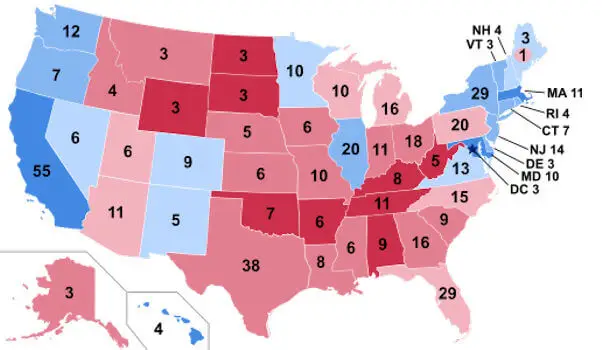 The NPV Compact is an end run around the Constitution. It states that once states with electoral votes equaling 270 enact the Compact, it will become the law without ever passing Congress and without being sent to the states for ratification as required to amend the U.S. Constitution.
NPV eliminates the geographic balance provided by the Electoral College, which makes all states, both small and large, liberal or conservative, important in a presidential election. A state’s electoral votes are based on the same formula used for Congress which was established by the Great Compromise that brought into being the U.S. Constitution. Each state receives two electoral votes for its U.S. Senators plus one vote for each of its Congressmen. For example, a small state like Nevada has two U.S. Senators and four Congressmen equaling six electoral votes. California has two U.S. Senators plus 53 Congressmen equaling 55 electoral votes. The Electoral College gives small states a slight advantage, but that advantage would vanish with NPV. Small states would become meaningless flyover states in presidential elections. Only big population states like California, Florida, New York, and Texas would matter.
The Electoral College protects us from vote fraud by providing 51 individual elections in the states and District of Columbia, not just one election which can more easily be stolen. The Electoral College protects us against the instability of nationwide recounts and endless lawsuits. The NPV scheme would increase the stakes for voter registration fraud and vote fraud.
NPV sets up a system of betrayal of the voters. The proposed compact is not a pure popular vote, but a hybrid system that would keep the Electoral College in place by creating a vote-stealing scheme to compile a NPV winner. Under NPV, if a state votes for the Democrat presidential candidate, but the NPV winner is determined to be the Republican or the Independent, the Secretary of State or chief election officer would be forced to betray his state’s voters to certify presidential electors for the candidate who did not receive his state’s popular vote. This kind of manipulation and betrayal will infuriate the voters and subject those who supported such a vote-stealing scheme to their wrath.
There is no national authority for determining the accuracy of the NPV for president. The proposal requires the chief election official of each member state to determine the number of votes for each presidential slate in each state of the United States and the District of Columbia in which votes have been cast in a statewide popular election and shall add such votes together to produce a “national popular vote total” for each presidential slate.
So each Secretary of State or chief election officer would be responsible for determining the validity of the presidential election vote in all 50 states and the District of Columbia. Who is the arbitrator if states do not agree? There is no answer in the NPV Compact. We can expect endless court cases and no legitimate president elected for months.
Currently, the Director of the Federal Register is designated by the Archivist of the United States and is responsible for obtaining, from the states, the certificated results of the election. There is a careful process for determining the correct election results. There is nothing comparable to that well-defined and safeguarded process in the NPV Compact. How will the public be able to trust the election results by 51 chief election officers when there is no national process to certify the votes? Adding to the confusion, some states have even failed to send their election results to the Archivist of the United States.
What happens if, as a part of the Compact, a state’s Secretary of State or chief election officer designates a different NPV winner from the one of the other states in the Compact designate? What if a chief election officer of a state wherein the popular vote differs from the NPV “winner” refuses to betray the voters in his state and does not certify the electors for the NPV “winner”? Will the other states take that state to court? Will it throw the election into the hands of the Supreme Court? What happens, as just happened in a North Carolina Congressional race, if voter fraud is discovered and the election is overturned? Does that nullify the NPV total and nullify the presidential election? Will it result in endless recounts and lawsuits? Does it delay the election of the president throwing the nation into a constitutional crisis and political chaos?
According to NPV Compact supporters, they are more than 72.6 percent towards their goal or just 74 electoral votes short of putting the Compact into effect! The following States, plus the District of Columbia, have already signed onto the NPV State Compact: California (55), Connecticut (7), District of Columbia (3), Hawaii (4), Illinois (20), Maryland (10), Massachusetts (11), New Jersey (14), New York (29), Rhode Island (4), Vermont (3), Washington (12), Colorado (9), New Mexico (5), Delaware (3), and Oregon (7), equaling 196 electoral votes.
NPV is targeting Republican states. They hire Republicans legislators, lobbyists and former Congressmen to go to any state where NPV is introduced in order to seduce more Republicans into supporting it. Saul Anuzis, former Republican Chair of Michigan, has worked for NPV for years lobbying across the country. In addition, Michael Steele former Republican National Chair is supporting NPV, even though the National Republican Committee voted to oppose it. These operatives have been successful in getting bipartisan support in Republican states, including Arizona, Michigan, Missouri, and Oklahoma. Eight former chairs of the American Legislative Exchange Council have endorsed NPV.
The NPV Compact has no minimum percentage for a candidate to be declared the NPV Winner. In a three-way race, a candidate could win with 35 percent of the popular vote or even less. Because the NPV Compact has NO minimum percentage required for the NPV winner, voters could elect a candidate with no national mandate. Consider the national disaster of having no President elected for six to nine months after the election. Professor of law at the University of Denver’s Strum College of Law, Robert Hardaway, wrote in the Huffington Post in November 2017, “How the Electoral College Saved the Day. Again.” In it, he explains the endless recounts and court challenges that NPV would unleash:
During the 1992 presidential election, Ross Perot, a wealthy Independent candidate, received 19 percent of the vote that likely caused George H.W. Bush to lose his second term to Bill William Clinton.
Before Perot withdrew and then reentered the race, he was polling at 39 percent. Although Perot received no Electoral College votes, in an NPV Election that does not matter. If Perot had received 39 percent of the popular vote, he would probably have obtained enough votes to be named the NPV winner. Before the 1992 election, Republican Bush polled at 31 percent and Democrat Clinton polled at 25 percent.
Today there are more third parties, which would also deprive the major parties of votes, including the Libertarian Party, Independent American/Constitution Party, and Green Party. As many as 42 percent of Americans identify themselves as “Independents”.
We should not allow the NPV to create instability by jeopardizing what the Electoral College has provided for over 232 years — the peaceful transfer of power. NPV is a dangerous threat to our Republic.