by John Daniel Davidson, Senior Fellow, Texas Public Policy Foundation, Congressional testimony reprinted with permission
I visited a migrant respite center in McAllen, Texas, run by Catholic Charities of the Rio Grande Valley, established in 2014 when Immigration and Customs Enforcement was overwhelmed with thousands of children and teenagers turning themselves in to Border Patrol agents. One year ago, the center was receiving between 60 and 120 migrants a day, nearly all of them families from Central America. Today, a larger respite center is receiving about 800 people a day. The Sunday prior to my testimony before Congress, 1,300 people were dropped off by ICE.
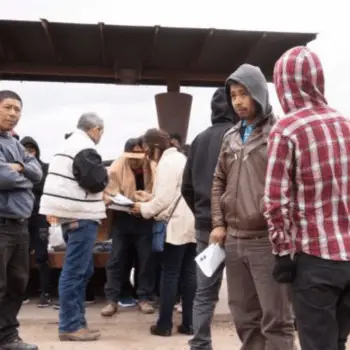 Every afternoon, ICE dropped off migrants at a Greyhound bus station whose employees would then call the center to send vans to pick them up. Once at the center, the migrant worked with volunteers to get in touch with family members all over the country. The goal was to get them all bus tickets and send them on their way that same day to prepare for the next days group of adults with children.
McAllen, a city of fewer than 150,000 residents, daily receives thousands of migrants discharged from ICE custody, wandering the streets and sleeping in doorways and on park benches as neighbors complain about constant traffic and strangers wandering nearby streets where children play. The situation in McAllen is an emergency, but that’s just one border town in Texas. Something similar is playing out up and down the U.S.-Mexico border.
In El Paso, thousands of migrant families are turning themselves in to Border Patrol every day, overwhelming federal facilities and personnel. In five-minutes one day in March, Border Patrol apprehended two different groups totaling 400 people.
The Rio Grande River is shallow in El Paso and easy to walk across. Migrants walk across the river, continue a hundred yards to the border fence, and then follow the fence until they reach one of the gates. There, they simply wait for Border Patrol to arrive with vans to pick them up.
On the night of President Trump’s rally in El Paso in February 2019, a group of 300 turned themselves in to the Santa Teresa Border Patrol station 22 miles west of El Paso. Since then, things have gotten worse. Even smaller and relatively remote communities are seeing large groups of migrant families turn themselves in. Recently, a group of nearly 60 was apprehended near the port of entry in Eagle Pass, Texas. In February, a group of 90 was apprehended in the tiny town of Quemado, Texas, population 230. That group included children as young as one year old and a pregnant woman who, upon arrival, went into labor and later gave birth.
As mass numbers of migrants are being released from federal custody along the border, cities further inland have also begun to feel the effects. In March, about 1,000 migrants arrived in San Antonio on buses from the Rio Grande Valley. Non-profit groups are struggling to house and feed them, and have appealed to municipal authorities for assistance. The process and logistics are haphazard and fluid. No one is really in control.
Pattern Among Asylum Seekers
As I talked to migrants, a pattern emerged:
- A majority of the “family units” are men traveling with one or more children;
- Many of these men say they have a wife and other children back in their home country and that they intend to secure work in the U.S. to send money back home;
- They have family members or friends across the U.S. Many have jobs lined up;
- Nearly all say they left their homes because it is dangerous, citing gang violence, and threats. They are all claiming asylum;
- Many admitted that they don’t plan to remain in the U.S. permanently and in fact have a set amount of time they plan to live and work here before returning home;
- All of them say they paid a smuggler to secure safe passage to the border (the amount varies from $2,000 to $6,000 per person). Despite the challenges and dangers they face in their home countries, the vast majority of these people are economic migrants; very few of them have valid asylum claims. They are not trying to evade U.S. authorities. In fact, they are seeking Border Patrol agents out in order to turn themselves in.
Previously, when these migrants were processed and released by ICE, the adults would be outfitted with an electronic ankle monitor. If they failed to check in at designated times or traveled outside a certain radius, immigration authorities would be notified. The ankle monitors are a major piece of ICE’s Intensive Supervision Appearance Program, an alternative to detention for those in immigration proceedings. A former Border Patrol agent told me that almost everyone released with an ankle monitor cuts it off and absconds, effectively abandoning their asylum claim.
Billion Dollar Smuggling Industry
From the moment Central American migrants cross Mexico’s southern border and begin their journey north, the entire process is a massive, multifarious, black-market, money-making machine. Smugglers, corrupt local officials, truck drivers, lookouts, loan sharks, and Mexican drug cartels exert absolute control over the migration flows in Mexico and have refined it into a lucrative business enterprise.
Exact figures are unknown, but a simple calculation will give you an idea of the amount of money changing hands along the migration pipeline. Customs and Border Protection Commissioner Kevin McAleenan said that the agency was on pace to apprehend more than 100,000 migrants in March. Assuming each migrant pays, on average, $4,000 for safe passage over the border, that’s about $400 million — just for those apprehended crossing illegally in March.
Chief beneficiaries of this pipeline are Mexican drug cartels, which exert iron-fisted control over their territory. Cartels generally require every man, woman, and child who passes through their territory on the way to the U.S. border to pay a tax. Otherwise, migrants cannot cross the Rio Grande, and are at risk of being kidnapped or otherwise exploited.
The amount of money cartels are making off migrant smuggling is substantial. For example, 162,000 people were apprehended in the Rio Grande Valley sector in fiscal year 2018. If each one paid an $800 tax — a conservative estimate — that means the cartels in this region made nearly $130 million by taxing people moving through their territory.
The black market for migration is remarkably sophisticated. At its inception point, in villages and towns across Central America, the market works mostly through word of mouth. If you want to migrate, you contact someone whose family member or neighbor migrated, and they put you in touch with a local smuggler who quotes a price or sometimes a range of prices contingent on certain conditions. For example, one Honduran man was quoted $7,000 on the condition he bring his 6-year-old daughter and they agree to surrender to Border Patrol once they cross into the U.S. Otherwise, the price would be $10,000. The reason for this difference in price is that it is much easier for smugglers to transport migrant “families” intending to claim asylum in the U.S. than migrants who want to enter the country undetected. Instead of crossing with the migrants and trying to evade Border Patrol, both at the border and at checkpoints further inland, smugglers transporting asylum-seekers need only to take them up to a crossing-point on the Rio Grande and tell them when to go over. There is zero risk for the smugglers themselves, hence the cheaper price if an adult brings a child along.
Smugglers tell potential migrant families that if they claim asylum, they will be allowed to stay and work, which is due to the immense backlog in U.S. immigration courts, with wait times for a hearing of up to three years.
Smugglers Exploit Families
The growing prices disproportionately affecting the Rio Grande Valley and El Paso is being driven by three major factors:
- It’s easier for minors or families to enter the U.S. now than it was during the Obama administration since there is no room at detention facilities and families can expect to be released soon after detention.
- Smugglers are marketing a sophisticated, efficient busing package to people — women, families — who do not want to undertake an arduous or dangerous journey. Word has gotten back to communities in Central America that they will not be long detained once they enter the U.S.
- Conditions in Central America have not improved. Persistent poverty, violence, and corruption, combined with the fear that it’s not going to be this easy to get into the U.S. forever, are prompting “families” to come now.
There is no easy solution to this crisis. Border security is part of the solution, but so is congressional action. As long as Central American groups know they can gain entry to the U.S. by initiating asylum proceedings upon crossing the border, this will continue. As long as cartels and criminal networks know they can profit from trafficking migrant families to the border, they will do so. And as long as conditions in Central America continue to fester, families in those countries who can pay for it will seek a better life for their children by traveling north.