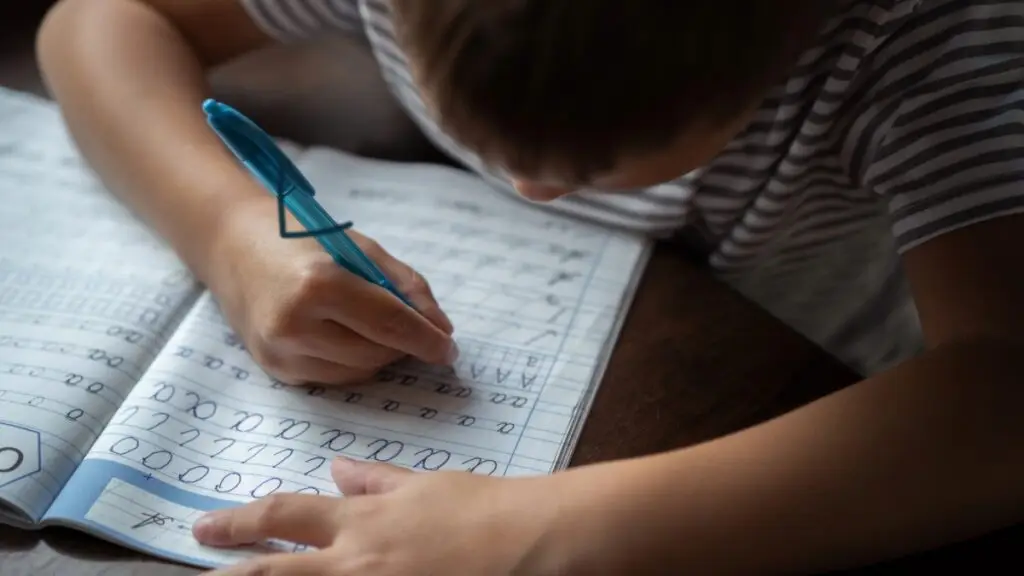
Here is an excellent bipartisan bill: bring back the teaching of cursive writing in elementary schools. Missouri Rep. Tricia Byrnes is sponsoring HB 2230 which would limit the use of technology in elementary schools and increase the use of pen and paper. This sensible bill would limit digital instruction to no more than 45 minutes per day for students in kindergarten through fifth grade. Furthermore, the computer instruction shall not replace real-time live instruction in reading, arithmetic, and cursive handwriting.
There is ample evidence that computer screen time is not beneficial to children’s eyes, and the blue light interferes with sleep. Parking the child in front of a screen is not true teaching and comprehension. Elementary school-age children crave personal interactions. In order to learn inter-personal skills, they need in-person teaching by a real, live human being. Even the titans of tech realize that their products are not suitable for young ages; many choose to send their own children to tech-free schools.
My favorite line in Rep. Byrnes’s bill is “At least seventy percent of student assignments for elementary school students in kindergarten through grade five shall be completed using pen or pencil and paper including, but not limited to, dedicated handwriting practice and cursive writing tasks for students in grade two through grade five.”
Politicians of both parties have supported the teaching of cursive. In the last ten years, multiple states have passed laws that mandate the teaching of cursive handwriting. Missouri should join this much-needed movement for teaching the basics in elementary school.
The campaign against cursive was started more than two decades ago when many states adopted Common Core State Standards, which emphasized keyboarding over handwriting. There are multiple reasons why student scores have dropped over these years, but dropping cursive did not help students succeed. I would argue that dropping cursive has contributed to the decline in learning and comprehension that we see in the abysmal test scores from so many schools in Missouri.
Opponents of teaching cursive, which include the teachers’ unions, claim that no one needs to write by hand because modern communication is all electronic, including signing checks. That’s just laziness, because writing cursive is actually very good for the brain. First, it reinforces that reading and writing are from left to right. Then, by handwriting, the brain has more opportunity to learn the lesson. The brain absorbs and holds the information much better when the time is taken to write by hand. Yes, writing in cursive takes longer to perform, but that is the point of learning. The computer keystrokes do not contribute stickiness to the brain.
When I type, I often confuse homonyms and I accidentally type “right” instead of “write” or “knew” instead of “new”. The fingers quickly learn and repeat the patterns of typing words without thinking. But when writing by hand, I never confuse the homonyms. Keyboarding is careless and handwriting is careful. When we handwrite the lesson, the concepts stick with us and we better remember the information.
If students do not know how to write cursive, then they cannot read cursive. If you only look at printed text, then handwriting looks like a jumbled mess. As we celebrate the semi-quincentennial of our nation’s founding, we want our students to be able to actually read the beautiful script writing of the Declaration of Independence.
Besides academic success, there is another very important reason for young people to learn to read and write cursive: to be able to write and read a love letter. A handwritten mash note is cherished much more than a text message. And what good is a handwritten profession of love if the recipient is unable to read it?

Share this:
- Share on Facebook (Opens in new window) Facebook
- Share on X (Opens in new window) X
- Share on LinkedIn (Opens in new window) LinkedIn
- More
- Share on WhatsApp (Opens in new window) WhatsApp
- Share on Telegram (Opens in new window) Telegram
- Share on Reddit (Opens in new window) Reddit
- Email a link to a friend (Opens in new window) Email
- Share on Pinterest (Opens in new window) Pinterest
- Share on Tumblr (Opens in new window) Tumblr
- Print (Opens in new window) Print