by Dr. Patricia Daugherty, president of Eagle Forum of Georgia. Article first published at thefederalist.com and read by Rush Limbaugh on his radio show
The Left need not depend on sociology and women’s studies faculty to radicalize our children; it’s being done quite effectively in student centers and residence halls.
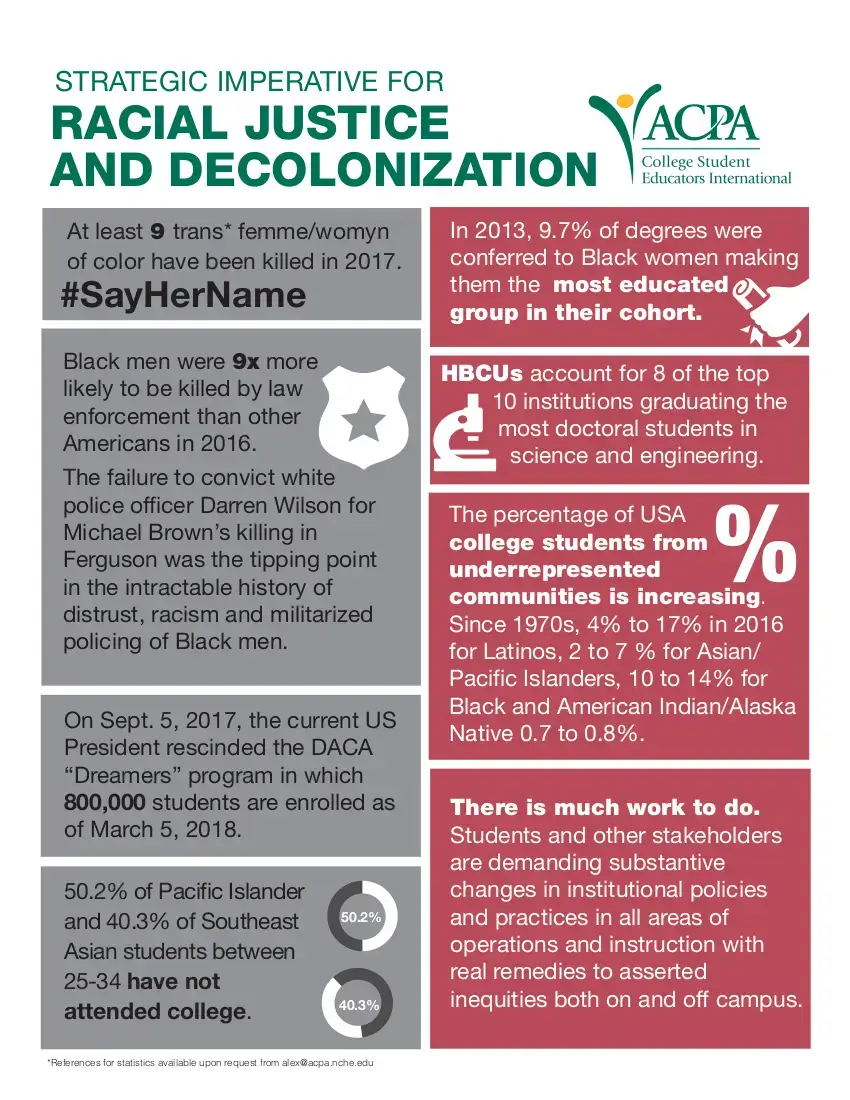 The extremely liberal environment on many college campuses is often attributed to the influence of aging hippie professors intent on indoctrination rather than education. But perhaps even more influential is the army of campus administrators who work with college students 24 hours a day, 7 days a week. My recent experience at a conference of such professionals revealed that indoctrination is not confined to the classroom.
Before retiring in 2015, I did “student affairs” work on university campuses for almost 40 years. I enjoyed attending the American College Personnel Association: College Student Educators International Conference to connect with colleagues who were dedicated to helping students adjust to being away from home, making new friends, and become successful citizens after they graduated.
This year’s meeting, however, was devoid of such old-school notions. What we got instead was far-left, social-justice politics.
Drinking Their Kool-Aid
With the theme of “Strategic Imperative for Racial Justice and Decolonization,” the conference provided these talking points: “Racism and colonization are real, present, enduring, intersectional, and systemic forms of oppression” and “Advocacy and social change require us to work to dismantle racism and colonization in higher education.”
The conference website highlighted blog posts such as “Racial Justice & Decolonization Can’t Happen Without Disrupting Monoracism” and “The Costs of Avoiding Discomfort: Addressing White Supremacy in Student Affairs.”
Attendees took an “I’ll Go With You” pledge to assist transgender attendees with restrooms: “I pledge to speak up against injustice. I will contact my elected representatives to make sure they know I support equity, justice and fairness for trans people in my country, state, city and neighborhood.”
There were designated “All-Gender Restrooms” because “[h]istorically, restrooms have been a way to reinforce sex assigned at birth (female/male) and gender (woman/man) identities and expressions, but as an Association, ACPA actively challenges traditional definitions of sex and gender.”
Reporting “Thought Crimes”
This convention, moored in the principles of tolerance and inclusion, touted the “ACPA Convention Equity and Inclusion Information Booth.” At this booth one could report any “bias incident . . . believed to have a negative impact on ACPA members, particularly across marginalized social identity group membership.” So if I asked a question that violated the thought police regulations, I might be reported? Welcome to Communist China.
Just before the welcoming video and keynote speaker began, a trigger warning flashed on the screen that there might be “disturbing scenes of activism” in the video. We then listened to Keala Settle’s “This is Me” as pictures were shown, not of happy college students of every background experiencing life on a university campus, but Planned Parenthood, Black Lives Matter, and the Women’s March.
The keynote speaker was a professor who expounded on “White Fragility: Why It Is So Hard for Whites to Talk about Our Racism.” I suppose she was selected because according to the program, “white supremacy culture permeates in [sic] the United States, with higher education and our campuses. Additionally, there is no doubt racism and colonialism exists [sic] on colleges campuses.”
The next morning I risked offending the equity and inclusion marshals by starting some conversations. To my pleasant surprise, no one shut me down. Perhaps it’s because my first musing was, “I wonder how my son would be accepted at this convention. He’s white. I’m white; his dad is white, so he can’t really help that he’s white, too. He’s straight — married with a 15-month-old son. And he’s a police officer. I wonder what assumptions last night’s ‘white fragility’ speaker would automatically make about him were he to walk into her office.”
I got nods from everyone to whom I posed this observation. This was a good sign, because I doubt if anyone in the conference planning had ever paused to reflect that 40 percent of college students are male and many of them are white, so maybe we shouldn’t lecture them about their failures and shut out their needs?
If You Missed 3rd Grade Grammar
At the ACPA Town Hall meeting that afternoon, the woman who welcomed us began by asking the officers and committee leaders to introduce themselves with their names and pronouns. These grown-ups stood up and said, “I’m John Doe, the new president, and my pronouns are he, him, and his.” Every person gave the pronouns I would have expected, i.e., male for the men and female for the women. One person did add “they” and “them,” but everyone knows plural pronouns are grammatically incorrect for singular antecedents.
I stifled a laugh, knowing it might land me in the equity and inclusion jail. I was amazed at how seriously they seemed to take themselves in this exercise. Not one of them resisted and said, “Are you kidding me?”
To further divide people during the conference, the schedule included “identity caucuses.” During this hour, attendees could meet with people “who shared their identity/ies” and talk about racial justice and decolonization. The caucuses included Arab/Middle Eastern; Asian/Asian American; Biracial/Multiracial/Transracial; Black/African American; International; Latino/a/x; Native, Indigenous, Aboriginal; Pacific Islander; Third Space; and White.
I have no idea what Third Space is. The program book stated participants should be able to “explore a deeper understanding of their own racial/political identities” and “engage with issues of power, privilege, and oppression in order to interrupt dominance.” Can you imagine these people planning the homecoming parade?
Administrators Are Influential
I write this not (only) to make fun of what I observed. I am sounding an alarm for Americans who need to know more about what is feeding the campus discord and upheaval.
“Those liberal professors” share the blame for the sanctimonious silliness, but the administrators often have much more personal contact with students. They advise student government, supervise residence hall staff, and oversee the student code of conduct and “free speech” policies.
When I came along in my student affairs master’s and doctoral programs, we were taught about psychology and normal maturational issues of 18- to-22-year-olds. We learned how to be objective counselors, supervise and develop groups, and teach leadership skills to young adults who would one day lead our communities. We supported all of our students — black, white, Asian, Hispanic, Native American, gay, straight, and international. We tried to create environments where everyone could succeed, and when conflicts arose, we helped students learn how to solve their problems.
Now, college students are surrounded by adults who live and breathe an extreme political ideology. No more judging people by the content of their character instead of the color of their skin. No more encouraging everyone to come together around their commonalities rather than focusing on every possible difference. It was disheartening to see and hear so much stereotyping from people who pride themselves on their inclusiveness.
Ideology Drives the Staff
Particularly alarming is that political ideology has become a dominant theme of student affairs graduate programs. As an adjunct assistant professor, I graded the “student development theory” question on the master’s students’ exams.
The political self-absorption I saw promotes not emotional growth and resilience but rather distrust, anxiety, and victimhood.
Students formerly wrote about young-adult psychology and how to apply their understanding of normal development in working with undergraduates. In more recent comprehensive exams, however, the answers were treatises on white privilege and explanations of Nigrescence Theory, born of the black consciousness movement of the 1960s.
This type of dogmatism and tunnel vision is profoundly unhealthy for our students. Young people are more fragile now than they have ever been, and I’m afraid student affairs is playing a major role in the angst. The political self-absorption I saw promotes not emotional growth and resilience but rather distrust, anxiety, and victimhood. College students need mentors who are more concerned with their developing competence and strength than with which pronouns they use.