The following is an excerpt from Heritage Foundation President Kevin Roberts’ new book, “Dawn’s Early Light: Taking Back Washington to Save America,” released Nov. 12.
Have you ever driven through a blizzard in Wyoming?
Your field of vision doesn’t extend more than twenty feet. There are only the storm and the road, except for the occasional butte or buffalo. Silence descends on the glacier-carved valleys as ice and snow pile up and muffle all sound. The grizzlies seek shelter. You want to do the same.
The frontier is dangerous. It is majestic yet simple. It is imposing yet liberating. It is, in short, the most American thing there is.
And like those ancient glaciers that permanently reshaped the landscape of the West, Americans have been carving civilization into the stone since the Pilgrim fathers’ “errand into the wilderness.”
Still, the frontier has changed us much more than we will ever change it. Land shapes behavior. Western blizzards formed a people with distinct habits and customs; westerners couldn’t survive in such a land if they didn’t have a spirit of perseverance, toughness, and adaptability. The very unavoidability of nature gave people a healthy appreciation of mortality and chance.
Other American landscapes did the same. The Cajun culture of Opelousas, for example, is indelibly intertwined with the forests and bayous where my ancestors settled. The same is true of the descendants of the brave men and women who followed Daniel Boone through the Cumberland Gap and settled large swaths of Ohio, Kentucky, West Virginia, and Tennessee—and of the pioneers who pushed across the Great Plains, past the Rockies, and to the Pacific Coast. Those mountains made them.
As much as the natural diversity of her people, the variations of America’s landscape created a need for federalism. As each group of people adapted to each unique landscape, America developed diverse local cultures, economies, and institutions that made federalism both necessary and sensible.
At the same time, the experience of settling a wild yet bountiful land was common to them all. The rugged individualism and true grit demanded by the frontier forged the American spirit.
That’s a big part of what makes America unique. Our frontier tends to shape explorers, astronauts, cowboys, and innovators. A frontier attitude is one of risk taking, hard work, and optimism.
Our elites once understood this spirit. Andrew Jackson, Abraham Lincoln, even Barry Goldwater (who was born in the Arizona Territory) all came from the frontier.
But this is no longer the case. For those who are stuck in big cities on the coasts, the frontier has become nothing but a setting for movies and video games, and federalism a hollowed-out idea from a dead letter.
So what happened? When did we lose sight of the American frontier, and how can we reclaim it?
That story begins and ends in California. That’s because California wasn’t always the progressive hellscape it is today.
For most of its history, California occupied a particular place in the American and Western imagination: it was the end of the frontier, the edge of the Western world, the place where the sun sets.
From priests such as Father Junipero Serra, who rode on muleback as he founded California’s first missions, to pioneers such as Augustus T. Dowd, who discovered sequoia trees while tracking a wounded grizzly through unfamiliar territory in 1852, that spirit—of adventure, of pushing onward, of spreading the Gospel to every corner of the world—was what California was all about.
Even after the American West was settled and civilized, California continued to open new frontiers. In 1912, Charles “Doc” Herrold of San Jose, California, became “the father of broadcasting” with the first regular radio broadcast, part of a ferment of tinkerers that would eventually result in Silicon Valley. In 1923, Walt Disney and his brother Roy founded the Disney Brothers Cartoon Studio in Hollywood, with a revolutionary animation system that would open new frontiers of the imagination. In the 1930s, scientists in Pasadena doing pioneering work in rocket propulsion founded the Jet Propulsion Laboratory, which has since gone on to send spacecraft to every planet in our solar system and land five rovers on Mars.
Is it any wonder that Ronald Reagan, a native son of California, was adamant about exploring the “next great frontier” and rebooting America’s space program? Deeper, farther, higher: that’s California, or at least it was.
But there was always another nightmare version of the California dream. For every would-be astronaut exploring outer space, there was a psychonaut of “inner space” looking to conquer the frontiers of human consciousness: Eastern yogis, Pentecostal preachers, Esalen seminar leaders, New Age gurus, LSD chemists. It’s no coincidence that Steve Jobs, living on an LSD-soaked orchard commune, chose an apple with a bite out of it as his computer’s symbol. “And ye shall be as gods, knowing good and evil.”
After decades of development, Silicon Valley in the 1990s promised to open the next tranche of the California frontier: the internet. What had made the frontier great was that it had enlarged Americans’ imaginations. It had drawn us out of ourselves to the horizon. It had challenged us and made us strong. It had taught us the importance of freedom, but it had also reminded us of the fragility of our human condition and taught us to rely on God and on one another.
The internet can provide powerful tools for would-be explorers and pioneers.
But mostly, that wasn’t what Big Tech built.
Rather than expanding the American frontier, Silicon Valley inverted it, both metaphorically and literally.
Once again, the frontier has changed us more than we will ever change it; this time for the worse. It has disembodied us. More and more, our bodies and brains are becoming the frontier being explored and the Big Tech algorithms and Deep State surveillance the explorers
The Deep State, whether by intention or accident, aims to put the American spirit on puberty blockers; to domesticate our free people into “a flock of timid and industrious animals, of which the government is the shepherd.”
The thing is, the frontier is dangerous. It’s wild. It’s violent and sometimes disorderly. “The meeting point between savagery and civilization,” the historian Frederick Jackson Turner called it. The federal government has always had a role in mediating between the frontier and the republic writ large. But the United States is so vast that there’s always been plenty of room.
There’s a myth that the frontier “closed” with the end of U.S. territorial expansion. But anybody who has spent time in the Big Sky Country of Montana, in the great Alaska range, in the vastness of the Great Plains, in the West Texas valleys that go on for days, knows that this isn’t really true. The frontier is alive and well.
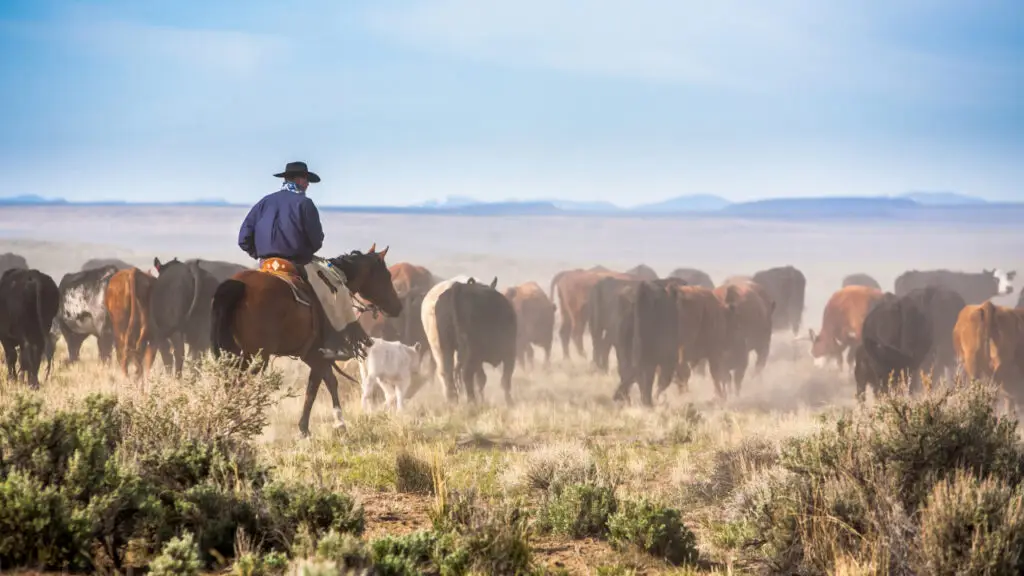
What changed was the growth of the federal apparatus throughout the twentieth century. The job of the federal marshal in the Wild West was to restore order when the cowboys couldn’t quite manage. Today’s Deep State treats us more like the cattle.
The defenders of the Deep State will say that [important] reforms … will make us less safe.
They’re right.
Being a free person is dangerous. It demands responsibility, resilience, self-reliance, and humility; virtue, in a word.
I can picture in my mind’s eye the choice words that the Wyoming ranchers of my acquaintance would have for a nanny-state bureaucrat who warned them that hunting bears or rolling their own barbed wire wasn’t safe. Safety imposed via surveillance breeds fragility and weakness. In the diktats of the Deep State, we should hear the nagging voice of the overbearing helicopter mom: “Why don’t you play inside, where it’s safe?” “Why don’t we wear two masks, just to be safe?” “Feeling anxious about your body changing? We should put you on puberty blockers, just to be safe.”
The Constitution is being overthrown by a new form of tyranny based on federal centralized control, surveillance, and weaponized law enforcement. Against the stifling safety of the New Authoritarianism, we need to reclaim within our souls the spirit of endless frontier federalism.
Even as we do what we can to fix Washington, we need to sever the apron strings and reacquaint ourselves with self-government at the state and local levels. Doing so will at times be messy and dangerous. But it will be a gymnasium of the frontier spirit.
Kevin Roberts, Ph.D., is president of The Heritage Foundation and Heritage Action for America. His new book, Dawn’s Early Light: Taking Back Washington to Save America, was released Nov. 12.
Share this:
- Share on Facebook (Opens in new window) Facebook
- Share on X (Opens in new window) X
- Share on LinkedIn (Opens in new window) LinkedIn
- More
- Share on WhatsApp (Opens in new window) WhatsApp
- Share on Telegram (Opens in new window) Telegram
- Share on Reddit (Opens in new window) Reddit
- Email a link to a friend (Opens in new window) Email
- Share on Pinterest (Opens in new window) Pinterest
- Share on Tumblr (Opens in new window) Tumblr
- Print (Opens in new window) Print