It’s as radical as it sounds.
As parents and taxpayers discover more about what is taught in many local schools, national education leaders’ extremism continues to be exposed. The new evidence? Fox News correspondent Aishah Hasnie’s recent report1 that the U.S. Department of Education has recommended Abolitionist Teaching Network2 resources for schools as they prepare to reopen in the fall.
Abolitionist Teaching is a new concept to the public at large.
Most people have never heard of the Abolitionist Teaching Network because it was not created until July of 2020. Dr. Bettina Love,3 a Professor in Education at the University of Georgia, has been touted and awarded over the past few years in the world of higher education, Black queer feminist scholarship, and liberation for students of color. Now she has inroads with the Biden administration’s Department of Education, as recently explained by Stanley Kurtz4.
Describing Love’s 2019 book, We Want to Do More Than Survive5, as ”arguably the single most comprehensive and up-to-date guide to the ideology of the CRT movement in education,” Kurtz presents critical insights into Love’s background and her rise to becoming such a popular leader of progressivism in education. She is engaging and persuasive while espousing extreme leftist ideologies, which is why there is such an enthusiastic endorsement of her philosophies in teacher and school administrator training.
An alarming first conference.
After founding the Abolitionist Teaching Network and spending a year speaking and consulting at universities, corporations, and teacher education programs, Love hosted ATN’s first annual professional conference in July of 2021. This virtual 2 ½ day event showcased the ideologies that Hasnie6 and Kurtz7 have uncovered.
What is Abolitionist Teaching?
According to someone who attended the conference, the goal of Abolitionist Teaching is to “free Black and Brown children from their imprisonment” in White supremacist schools. The view is that White supremacists build the schools, make the rules, and create a police state. BIPOCs (Black, Indigenous, and People of Color) have no chance in the education system, so “the system must be dismantled,” as Bettina Love proclaims.
ATN could not be more serious about its goals.
 A quick perusal of the Abolitionist Teaching Network’s website8 shows how much this group has accomplished in its first year of existence. Resources for agitators are plentiful, from the Guide for Racial Justice and Abolitionist Social and Emotional Learning (the publication to which the U.S. Department of Education referred in its handbook for schools’ reopening)9 to the “Activists in Residence” program,10 described as “the heart of ATN’s work.”
Money has poured into its coffers.
Registrants for the online conference received an email in advance of the event that reported how lucrative the Abolitionist Teaching Network’s first year was. More than $400,000 came in from 8,000 individual donors, while $500,000 was received from “philanthropic” organizations (the organizations were not named). ATN gathered 50,000 followers on social media, and almost 22,000 tickets were purchased throughout the year for speaking events and consultations by Dr. Love and others on the ATN team. According to the brief report, ATN used $60,000 of this income to distribute grants to individuals and groups across the country.
This is not a localized movement.
More than 220 attendees were online at the virtual conference, with registrants from across the country: Pennsylvania, Minnesota, and California all the way to Georgia, Iowa, and North Carolina. Even Toronto and Puerto Rico had representatives. Most of the speakers were teachers, writers, and activists who are well-known in Black Lives Matter-inspired movements.
At the beginning of the opening session, Dr. Love enthusiastically welcomed her fellow Abolitionists before reading her “Statement for the haters because I know you’re out there.” Love encouraged participants to live tweet from the conference, but they were not to record or archive the sessions. An active Zoom chat continued throughout the 2 ½ days.
Several common themes dominated the presentations.
An overriding theme among the speakers, the panel discussions, and the online chat was that White supremacy is everywhere and must be resisted. Love reminded everyone that “White supremacy doesn’t take vacation days,” so everyone must be ready at all times to fight for freedom. As described in the ATN Guide to Racial Justice and Abolitionist Social and Emotional Learning, Abolitionist teachers must build a culture12 where there is “a commitment to learning from students, families, and educators who disrupt Whiteness and other forms of oppression.” After all, as one conference presenter asserted, “A White child should be traumatized that their (sic) ancestors did the lynching.”
Organizing and activism in schools are the priorities.
In almost every session, speakers promoted the importance of organizing in educational settings and helping teachers become vocal activists. One organizer from Seattle described how “purposeful organizing” will get Black Lives Matter into the schools to “collectively” fight against White supremacy – “Otherwise we won’t survive; they will pick us off.” Another discussion focused on “Activism in Early Childhood Education,” where a panelist declared, “The goal is not to train activists, but if we do it right, they (the children) will decide to become activists.”
Eliminate policing in schools
Another predominant conference theme was “Eliminating Policing in Schools,” otherwise described as “disrupting the School-Prison Nexus and the Industrial Prison Complex (IPC)” of the education system. One speaker described “Colonial Logic” in school policing. Supposedly this Colonialist attitude encourages School Resource Officers (security personnel) to develop trusting relationships with students, only to use the information they gather to later arrest those students and repress any potential resistance.
Capitalism is evil, except when you want to sell books.
While declaring the evils of capitalism and patriarchy, Dr. Love and many of the speakers mentioned their books and manuals on Abolitionist Organizing, De-Policing, Educating for Liberation, Anti-racism, and the importance of breaking down the Binary Gender Construct (“Binary is a toxic legacy of Colonialism”). Many of the activists travel across the country charging exorbitant speaking fees ($11,000 for a speech or $20,000 for two days of consulting is not uncommon), which universities and corporations gladly pay in their anxiety to atone for their White privilege. One activist, when describing her struggle for freedom from oppression, suddenly interrupted her thought with, “I apologize for the noise in the background. My landscapers just arrived.” Oppression, indeed.
Queerism is inherently Abolitionist.
A topic that involved almost all of the other issues was Queerism. This final conference session opened with the panel moderator’s statement that “You can’t be queerphobic, transphobic, or homophobic and be an Abolitionist.” All of the queer panelists described the importance of eliminating capitalism, abolishing prisons, and finding liberation from “heteropatriarchal norms.” Hate crimes laws are not helping because “there is still violence toward Black trans women” who are discriminated against in jobs (After all, “sex work is still work,” according to one panelist.) What would help would be to “Defund police departments and use the money for land developments for people who are trying to live outside capitalism. We can do this tomorrow!”, she/he exclaimed.
Another activist stated that “Our greatest queer teacher is ecology or nature. Ecosystems generate exceptionally diverse habitats that are very queer” because “binaries do not exist in nature.” Science teachers everywhere should be cringing.
This is not an extension of the Civil Rights Movement.
 It is important to understand that Abolitionist Teaching and other anti-racist theories are not simply continuations of the 1960s Civil Rights Movement. Peaceful protest is not the standard. “Blow it all up and start over!” is the mantra, with Abolitionist Teachers leading the charge to topple the education system. The language is especially revealing as Abolitionist educators describe themselves as co-conspirators, agitators, and liberators. One conference speaker said, “We don’t exclude Martin Luther King, Jr., but we don’t have his picture in our Freedom School materials.”
What is the damage to our children?
Children who do not notice skin color are being taught to hate themselves and each other. Black and Brown children learn that they will always be oppressed, and there is nothing they can do about it. White children learn that they are and always will be oppressors who must constantly repent. Even viewing people from a color-blind perspective is considered racist, not admirable.
Those who either deny this is happening in schools or are completely unaware of the ideologies must wake up. The public rhetoric can be misleading while the private mobilizing is proceeding at full speed. Even though the U.S. Department of Education walked back its endorsement13 of Abolitionist Teaching Network materials, do not be fooled. All levels of education bureaucracies support these philosophies to one degree or another, and teachers’ unions and colleges of education (the teachers of our future teachers) are the primary cheerleaders. They are already inserting these ideas into teacher education courses, professional development programs, and in-service training.
What can you do to guard your children against this indoctrination?
 Ken McIntyre, Senior Editor at The Daily Signal, recently received a letter from a Black mother that included excellent suggestions for positive ways to help your students resist the propaganda14. It all starts at home. As the letter writer suggests, creating book clubs led by retired teachers, introducing children to successful people who overcame difficulties in their lives, and visiting landmarks and monuments to share stories of why they are important are just a few of many easy ways to combat revisionist history.
Be informed and vocal in your schools, too.
Because Abolitionists seek to weave their messages throughout every class, it is important to know what is in all curricula. Explore the websites of your local schools and examine all materials that come home in your students’ backpacks. Ask for class syllabi. Tell your children to report to you15 any handouts, questionnaires, or surveys that call for them to “assess their privilege” or offer their (or their parents’) opinions that have nothing to do with legitimate class topics.
Parents have the right to opt out of activities they consider to be inappropriate or divisive. Most school districts provide the appropriate forms to be completed at the beginning of the semester. Recruit fellow parents and grandparents to attend school board meetings, even if it is simply to listen. If you discover alarming activities in any classrooms, speak up and demand change.
There is hope.
The good news about discovering radical movements like the Abolitionist Teaching Network is that parents and taxpayers are more alert than they have ever been. By being informed, creative, and vocal, concerned citizens can support each other in their efforts to provide foundations for success for all children, no matter their race or circumstance.
REFERENCES:
- Fox News correspondent Aishah Hasnie’s recent report – https://www.youtube.com/watch?v=BgwvCcoXFbE
- Abolitionist Teaching Network resources – theabolitionistteachingnetwork.org
- Bettina Love – https://www.edweek.org/leadership/opinion-empty-promises-of-equity/2021/01
- Stanley Kurtz article – https://www.nationalreview.com/corner/abolishing-america-biden-and-bettina-love/?utm_source=recirc-desktop&utm_medium=homepage&utm_campaign=right-rail&utm_content=corner&utm_term=first
- We Want to Do More than Survive – https://www.amazon.com/Want-More-Than-Survive-Abolitionist/dp/0807069159
- Hasnie report – https://www.youtube.com/watch?v=BgwvCcoXFbE
- Kurtz report – https://www.nationalreview.com/corner/abolishing-america-biden-and-bettina-love/?utm_source=recirc-desktop&utm_medium=homepage&utm_campaign=right-rail&utm_content=corner&utm_term=first
- Abolitionist Teaching Network – abolitionistteachingnetwork.org
- Guide for Racial Justice and Abolitionist Social and Emotional Learning – https://img1.wsimg.com/blobby/go/8d4b8aa7-b12e-4df8-9836-081a29841523/downloads/ATN%20Guide%20to%20Racial%20and%20Restorative%20Justice%20in.pdf?ver=1627087718726o
- “Activists in Residence” program – https://www.foxnews.com/us/abolitionist-teaching-network-far-left-group-cited-by-biden-administration-deep-ties-us-academia
- ATN Guide to Racial Justice and Abolitionist Social and Emotional Learning – https://img1.wsimg.com/blobby/go/8d4b8aa7-b12e-4df8-9836-081a29841523/downloads/ATN%20Guide%20to%20Racial%20and%20Restorative%20Justice%20in.pdf?ver=1627087718726
- ATN Guide to Racial Justice and Abolitionist Social and Emotional Learning, Abolitionist teachers must build a culture12 – http://criticalresistance.org/resources/the-abolitionist-toolkit/
- Even though the U.S. Department of Education walked back its endorsement – https://video.foxnews.com/v/6264699685001#sp=show-clips
- Excellent suggestions for positive ways to help your students resist the propaganda – https://www.dailysignal.com/2021/07/25/we-hear-you-nothing-nice-about-peddling-nice-racism-critical-race-theory/?utm_source=TDS_Email&utm_medium=email&utm_campaign=MorningBell&mkt_tok=ODI0LU1IVC0zMDQAAAF-gQMvZC2j60HrtuKnhJzWhAOBOzcFZR9rPPL6o5v1MkfdPJR-catDPOomUeXEy88iId11lrtfM4G9glVCWIRZRoJq8wnS2GHk6ZHa0yYSa1UOgHY
- Tell your children to report to you – https://www.foxnews.com/media/students-told-to-hide-equity-survey-questions-from-parents


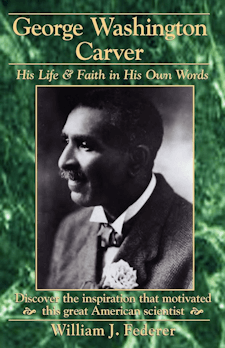 George Washington Carver: His Life of Faith in His Own Words
by William Federer
“Only alone can I draw close enough to God to discover His Secrets.”
The amazing story of George Washington Carver, slave birth, Iowa State graduate and Tuskegee Professor who revolutionized the economy of the south by discovering hundreds of uses for the peanut. “God is going to reveal things to us that He never revealed before if we put our hand in His,” stated George Washington Carver, 1924, to the Women’s Board of Domestic Missions in New York.
From slave birth to international fame, George Washington Carver advised Presidents, Congress, and world leaders. He was offered jobs by Thomas Edison and Henry Ford, but declined them as he determined to stay at Tuskegee Institute to help those less fortunate attain new and boundless opportunities.
Discover the faith that motivated this great African-American scientist to create and popularize hundreds of uses for the peanut, soybean, sweet potato and other plants, which revolutionized the economy of the South.