At the outset of the COVID-19 pandemic, government officials told us that if we just stay at home for a few days — maybe a couple of weeks at most — we could “flatten the curve,” reduce the spread of the deadly infection, and hopefully, return to normal.
Governors and local government officials enjoyed the nearly unlimited authority granted them through “emergency powers” laws. More than a year after the World Health Organization declared COVID-19 a global pandemic, freedoms Americans once saw as inalienable are still tenuous, often ignored by the dictatorial impulses of wannabe tyrants.
Americans are as divided as ever on just how much power government should have when it’s trying to “protect” us.
Early in the pandemic, most Americans were willing to put up with temporary restrictions on even our most treasured liberties if it meant demonstrating love for neighbor in a time of crisis. The key to that tolerance is, of course, that the restrictions be both temporary and necessary. Then days turned into weeks and weeks turned into months. Businesses closed, jobs were lost, and children across the nation lost an entire year of schooling.
All the while government officials acting with seemingly unlimited power were all too comfortable with violating even our most precious constitutional rights and, particularly, religious liberty.
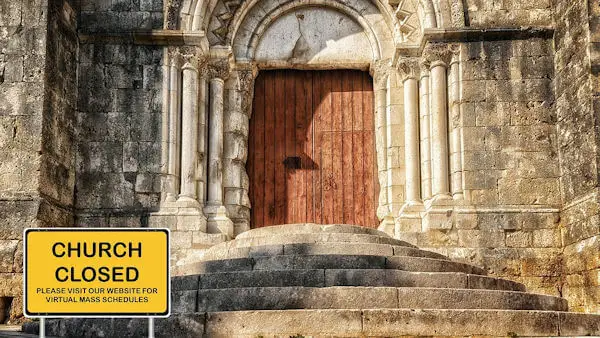
As the pandemic began, most churches chose to cooperate with public health officials, even if it meant temporarily foregoing the assembly of the saints until it was deemed safe enough to meet again. Many went online. Some hosted outdoor services with parishioners in their cars listening to sermons via radio or loudspeaker. Yet, churches still found themselves in the crosshairs of government officials. Some politicians, like Kentucky Governor Andy Beshear and Louisville Mayor Greg Fischer, tried shutting down outdoor, drive-up Easter services.
Thankfully, judges like Justin Walker — now a member of the Court of Appeals for the D.C. Circuit — stepped in and reminded the political class that we have something called the U.S. Constitution that still applies during a crisis.
Many churches have also defied the orders and continued holding services, most notably in California, New York, and Nevada where Democratic Governors Gavin Newsom, Andrew Cuomo, and Steve Sisolak, respectively, issued decrees that singled out religious groups for singularly harsh treatment while exempting liquor stores, gambling casinos, and big-box stores such as Walmart.
The result was dozens of court challenges across the country in which churches repeatedly won, culminating in some respects at Thanksgiving when the Supreme Court in a 5-4 decision struck down a Cuomo decree aimed at specific Christian and Jewish congregations in Brooklyn.
In Catholic Diocese of Brooklyn v. Cuomo, et al., Associate Justice Neil Gorsuch observed that “no apparent reason exists why people may not gather, subject to identical restrictions, in churches or synagogues, especially when religious institutions have made plain that they stand ready, able, and willing to follow all the safety precautions required of ‘essential’ businesses and perhaps more besides.”
More wins for religious liberty continued. Recently courts have ruled that the state of California must pay over $1 million in legal fees after losing court battles over its restrictions on worship. In a case involving First Liberty Institute, which represented Capitol Hill Baptist Church, the District of Columbia was ordered to pay more than $200,000 in legal fees after losing a court battle over its restrictions.
Even though violating the clear words of the First Amendment have cost state and local governments financially and led to multiple losses in court, will the bureaucrats learn from their mistakes? If the past few weeks are an indication, with the introduction of the Delta variant providing a new crisis opportunity, it appears unlikely. Already we have seen government officials drunk with power threatening to close down schools, churches, and businesses if freedom-loving Americans do not bow again to their authority.
What began as temporary soon became unending, and often, foolish. Guidance from once trusted sources like the Center for Disease Control and Prevention flip-flopped on a regular basis. Too often, politics seemed to drive decision-making, not science. The turning point for many was when 1,200 epidemiologists and public health officials released an open letter approving of the 2020 mass protests against “systematic racism” — while the same officials were demanding that churches, schools, and businesses shut down. The blatant hypocrisy did little to assuage the fear of many that science too had been politicized.
In recent months, some state legislatures are rethinking the authority they granted executives through emergency power legislation, changes that will hopefully lead to less abuse of power in the future. Several states, including Texas, passed bills that deem churches to be “essential” regardless of the crisis du jour.
The threat to our civil liberties is not over. The new battleground has shifted to vaccine mandates, with governments like New York and California (and some federal agencies) ordering all state employees to be vaccinated or lose their jobs. Many private employers, particularly those in health care, have issued similar directives. Courts will decide if mandates that do not allow for religious objections are constitutional. Those with deeply held religious objections to vaccines must request accommodations, particularly when other objections, such as medical, are allowed.
We entrust our judicial system and constitutional order to place limits on what government can do. The imminently more important question, only answerable by the American people, is what expectations “we the people” have for what government should do.
Since the 1930s, when President Franklin D. Roosevelt convinced Americans that central planning by experts in Washington, D.C. armed with a myriad of government programs and taxpayer dollars could end the Great Depression, principled inaction has been the rarest commodity in American politics. While the New Deal failed miserably at ending the Great Depression and in many ways lengthened and deepened it, Roosevelt succeeded in planting a ruinous seed in the American psyche that we should look to government for solutions to the inevitable imperfections of life in a world populated by imperfect people and institutions.
President Lyndon B. Johnson, unphased by his predecessor’s Quixotic crusade, launched an even more audacious one, the War on Poverty. Johnson’s Great Society was the promised inheritance of the New Deal and while the percentage of Americans living beneath the poverty line is roughly the same as before the War on Poverty this quagmire did succeed in one regard. Trillions of dollars have been transferred from people who work for a living to people who vote for a living. The ruinous seed planted by FDR took root and bloomed under LBJ.
It is human nature to be unsettled by the thought of forces beyond our control, like economic crises, generational poverty, or a new disease unleashed on humanity. Yet, we do ourselves no favors, and more often as shown by history we do ourselves more harm, when we demand government attempt to control that which we as individuals cannot. The result is more government control and less civil liberty.
While the promotion of the “general welfare” listed in our Constitution’s preamble would certainly include protecting the health of the people, the true purpose of government enshrined in our Declaration of Independence is protecting the God-given rights of the people.
There are many lessons to be learned from the Covid-19 pandemic. Crisis reveals character. Robert G. Ingersoll writing in praise of Abraham Lincoln said, “Most people can bear adversity; but if you wish to know what a man really is give him power.” This crisis certainly has revealed the character or lack thereof in many of our elected officials. However, we must also assess the revealed character of the American people. Our propensity to demand that government “do something!” about everything is what gave the aforementioned, revelatory power to those who abused it.
Only a return to the American ethos of self-reliance tempered with the Judeo-Christian call to love neighbor as self will result in a nation strong enough to withstand whatever challenges may come. We are justified in expecting government to protect our freedom. We are delusional in expecting government to protect us from ourselves. Lawyers and judges can protect our rights to life, liberty, and the pursuit of happiness. It falls to us then to live, live freely, and pursue what is good, true, and beautiful.
Share this:
- Share on Facebook (Opens in new window) Facebook
- Share on X (Opens in new window) X
- Share on LinkedIn (Opens in new window) LinkedIn
- More
- Share on WhatsApp (Opens in new window) WhatsApp
- Share on Telegram (Opens in new window) Telegram
- Share on Reddit (Opens in new window) Reddit
- Email a link to a friend (Opens in new window) Email
- Share on Pinterest (Opens in new window) Pinterest
- Share on Tumblr (Opens in new window) Tumblr
- Print (Opens in new window) Print