How could anyone objectively look at the current economic situation and not find the economy utterly broken? Perhaps because with many big companies deemed “essential,” and a stock market propped up by the Federal Reserve, it is easy to look at what appears to be economic strength and miss the glaring weaknesses.
While Walmart and Target continue to exceed earnings expectations, small businesses try to stay afloat. According to Alignable’s June Road to Recovery Report, “57% of small businesses have only reached half or less of the monthly revenue levels they achieved prior to COVID.” Shifting power and money from independent small business owners to a handful of big, powerful companies as a result of politicians’ mandates isn’t something that anyone should be arguing is a good outcome.
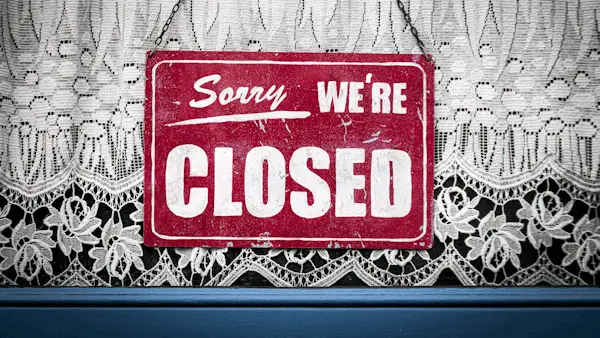
The Biden Administration recently projected that more than 400,000 small businesses closed permanently due to COVID, which is more accurately described as due to the government’s reaction to COVID. That closure number is likely low, as 400,000 permanent closures had been counted by The Hamilton Project all the way back in June 2020. Data from Opportunity Insights show that as of June 2nd of this year, there were 38.9% fewer small businesses open than there were in the beginning of 2020. While this number is likely high and representative of a subset of small businesses (such as those with employees), it is not hard to extrapolate that 7-figures worth of small business have likely closed for good.
Small business is undoubtedly the backbone of the economy, accounting for more than 99% of all business entities, and prior to 2020, around half the GDP and jobs. While not all small businesses were impacted by government mandates, small businesses overall bore the brunt of them. Those impacted small businesses that have survived thus far struggle to continue to do so. Alignable’s June Rent Report found that 37% of small business respondents couldn’t pay their rent in full and on time this month, an increase from just the month prior. Millions of small business owners are on the hook for six to seven figures worth of debt that they took on before the pandemic began, and much of that debt, according to the Federal Reserve, is personally guaranteed.
Those trying to make a case for heavy handed government mandates argue that people wouldn’t have patronized businesses even if there weren’t lockdown mandates. We can see that is blatantly untrue, because, as it turned out, many businesses were never locked down, and they did quite well, often at the expense of those who weren’t deemed essential. We never had anything that approximated full lockdowns and we were never “all in this together”. If we had all been truly locked down and the most powerful and well-connected were forced to share in the pain that those who were mandated closed felt, it’s reasonable to think the lockdowns wouldn’t have lasted even two full weeks.
However, as those big, connected businesses were not mandated closed, “15 days to slow the spread” turned into more than a year in some locations for the smallest companies.
None of these small businesses received appropriate compensation- eminent domain type of compensation- for subjugating their property rights. The Paycheck Protection Program was a fraction of overall relief, as well as a fraction of what was pumped into propping up the stock market. Moreover, it certainly was nowhere near enough to make up for the damage caused for the supposed “good of society”.
Arguing that the lockdowns saved lives isn’t based in reality either. You couldn’t get your hair or nails done in many locales, but you could get your dog groomed at a big box pet store down the road. There were no noted large COVID “death pools” related to any of these entities that stayed open- whether a pet store, an Amazon warehouse or a grocery store- in fact, staying open didn’t move the needle (or, you would imagine, they would have been shuttered).
Those states that took a lighter touch approach didn’t have worse outcomes than those with the heavy-handed approach in terms of deaths, but they did in terms of unemployment and business closures (New York, for example, still has 39.3% fewer small businesses open than in the beginning of 2020). In those locales with a more stringent approach, their own data didn’t support their conclusions. For example, New York City shuttered indoor dining at restaurants and bars late last year, even though only 1.4% of COVID cases via the state’s own contact tracing data were attributable to those entities — most came from inside the home.
Those entrepreneurs desperately trying to save their small businesses now can’t find workers and are dealing with broken supply chains making it difficult to get products needed for their business. This economic disruption is due to government interfering in the labor market by providing reasons not to work via enhanced unemployment benefits and direct stimulus paying, as well as making it impossible to work for parents with school-age children by not allowing the physical re-opening of government-funded schools.
If the government set out to reward big businesses and punish small ones, it would have looked exactly like this. It’s time we consider that they did set out to do exactly that.
Businesses have many more intentional government bullets to dodge ahead. Mandates that are currently being proposed are anticompetitive and would squarely hurt small business. From raising the minimum wage to the PRO Act, more heavy-handed regulation will make it harder for small business owners to start and to stay in business. Even raising corporate taxes would impact the 1.4 million small businesses organized as C-Corporations, and raising capital gains would further disrupt risk in the market and reduce investment available to small companies.
The implications of the government picking winners and losers are stark and severe. Half the economy is decentralized and looks more like a free market, in the hands of tens of millions of small business owners. The other half of the economy is concentrated in the hands of around ten to fifteen thousand big companies. These are companies that gained trillions of dollars in value and amassed more power via central planning over the last fifteen months, via a combination of the government and Federal Reserve actions. In fact, seven tech companies gained $3.4 trillion in value in 2020 while millions of small businesses were murdered by mandate or struggled to survive.
It is insulting and cruel to say the backbone of the economy wasn’t hurt by government lockdowns or other actions, or to pretend that the playing field was anywhere near level. Many small businesses were crushed and others continue to feel that weight on their shoulders.
Keeping the government from impacting small business should be a priority, and it’s easy: it just requires the government staying out of the way. Small businesses provide economic freedom for tens of millions of individuals to create wealth, to pursue their passion or to have the flexibility on how they want to provide for themselves and their families. Moreover, competition from decentralized small businesses leads to more jobs, more consumer choice, and better prices that benefit everyone.
Putting more power in big company’s hands is something good for politicians; heck, it’s easier to control or collude with thousands of big companies than tens of millions of small ones. But it is in no way good for the economy and pretending otherwise is a dangerous farce.
We must tell the stories of small businesses and what they have endured. We cannot let the government and media rewrite history. We must support small business with advocacy and our spending choices and not allow for the government to murder any more of them or face a future without the backbone of the economy.
Share this:
- Share on Facebook (Opens in new window) Facebook
- Share on X (Opens in new window) X
- Share on LinkedIn (Opens in new window) LinkedIn
- More
- Share on WhatsApp (Opens in new window) WhatsApp
- Share on Telegram (Opens in new window) Telegram
- Share on Reddit (Opens in new window) Reddit
- Email a link to a friend (Opens in new window) Email
- Share on Pinterest (Opens in new window) Pinterest
- Share on Tumblr (Opens in new window) Tumblr
- Print (Opens in new window) Print