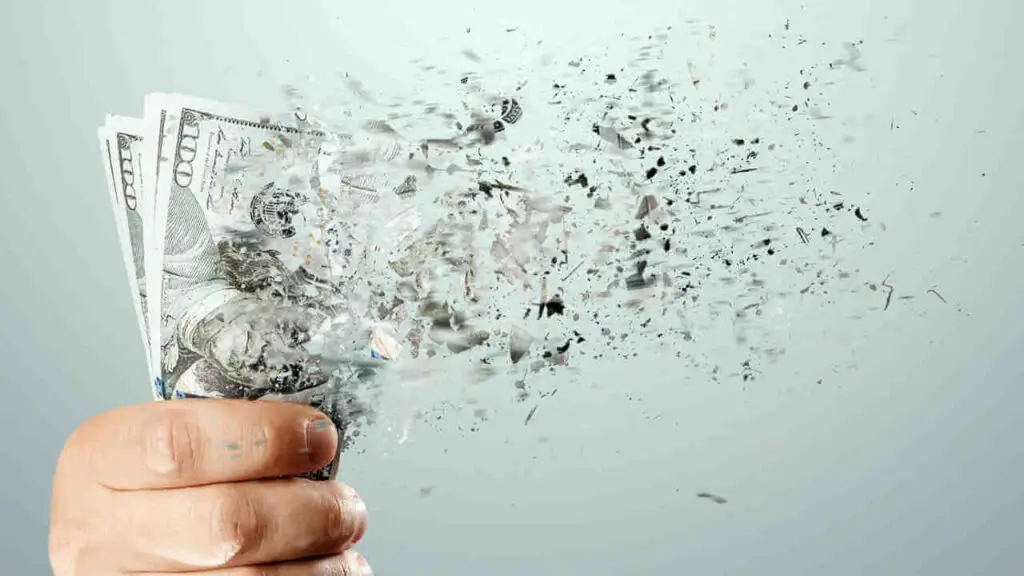
The purchasing power of the dollar bills in your wallet has declined 87.5% since 1971 (according to official government inflation measures). Basically, everything costs about eight times more.
What costs $1 today could be bought for 12 ½ cents in 1971 based on official government inflation statistics. The Federal Reserve notes you have in your wallet certainly buy a lot less today than they did 50 years ago. I remember that you could once buy a good candy bar for a dime. Now? Upwards of $2. Every American has felt the very real pinch of inflation.
You may not even have paper bills in your wallet. Everything is digital and you probably use debit and credit cards. Even those are antiquated compared to ApplePay. Still, all of this is based on the dollar unit which is at its core unbacked “fiat” money. Fiat comes from Latin and can be translated as “so let it be.” This means that if the government says it is worth something, it is. It is not backed by any physical commodity, but only backed by how much you trust the government. How much do you trust the government these days?
American dollars have lost purchasing power. Since 2000, inflation has made things 76% more expensive. Even since 2020, prices have gone up nearly 20%.
Here is another perspective: maybe the dollar has not lost value over 50 years? It depends on how you define the term. The word “dollar” as used by the Founders (and the Constitution) referred to something much more specific than a dirty green piece of paper with the picture of a dead president. It referred to a silver coin issued by Spain, a “Spanish milled dollar.” The value of this dollar was defined by weight and purity of silver in an amount well understood around the world. As explained by Edwin Vieira in a 1994 article published by the Foundation for Economic Education titled, “What is a Dollar?”
That’s sort of cool. The original concept of dollar was based on a “piece of eight,” which we know best as pirate treasure!
What made it a “piece of eight” was the contents of 371.25 grains (troy) of fine silver. That is 0.7734 troy ounces of fine silver (a troy ounce is 480 grains). You could divide that dollar into eight pie-shaped wedges, each valued at 12.5 cents. Two bits make a quarter, and four quarters make a dollar.
When you look at the purchasing power of the silver in a “piece of eight” over the past 50 years, you would have actually gained ground relative to the price of most goods and services. From this perspective, a “dollar” has more than held its value.
A good example is the price of gasoline. People could buy five gallons for a dollar (or ten dimes) a 100 years ago. The same deal is available today if you pay for the gas using the metal value of pre-1964 (90% silver) dimes (worth more than $20).
Are dollars good or bad? Depends on what you call a dollar. If we are talking unbacked paper money, then dollars are bad. The Founders knew this and were universally against “fiat” currency. Jefferson declared plainly, “Paper is poverty.”
In 1971, President Nixon shocked the world by completely abandoning the gold standard. He said it was “temporary.” The move made international waves but has been largely forgotten, as has the principle of sound money. That bad idea resulted in an 87.5% loss of purchasing power for Americans over 50 years.
Now, we have the government proposing something even worse, a Central Bank Digital Currency because they can’t print money fast enough. Using cash affords privacy and freedom, even if unbacked by precious metal. The next all-digital evolution, however, will deny freedom. Shekels become shackles.
On March 9, 2022, President Biden issued Executive Order #14067. It seemed innocuous enough. Sure, it was 37 pages long and had a lot of jargon, but it was exciting, especially to Bitcoin fans who seemed thrilled that the government would finally take them seriously. They had no idea it was poison-laced candy that really was a declaration of war on cryptocurrency and monetary privacy.
The EO concludes:
Sure, I want innovation, affordability, convenience. I want stability, integrity, and safety. But is my money supposed to deliver human rights, financial inclusion, equity, and halt climate change? This is simply enforcing the woke principles of ESG and DEI. Money should be neutral, not political. Team Biden views a digital currency as a means to enforce woke political policy and they aren’t even hiding it! Most experts agree that CBDC would be programmable money and allow the government a “line-item veto” of your spending.
So, what is the solution? As with many of our problems today, the answer can be found in the Constitution. Many will argue over whether Congress had the right to create a Federal Reserve, order the printing of unbacked paper money, or create CBDC. But absolutely, the States are allowed to make gold and silver coins “tender” in payment of debts according to Article 1, Section 10.
This ability to make gold and silver coins to be legal tender recently has been exercised in some states with many others considering it. There are a few problems. It’s hard to lug around doubloons and “pieces of eight” to pay for stuff. [Even if you could, the Coinage Act of 1857 banned the use of foreign coins as legal tender.] Gold and silver are taxed as “collectibles” even if they are legal tender, because they are not “functional money” according to the IRS. Functional money is defined as being able to conduct business broadly in a jurisdiction with that currency. British pounds are not functional money in America. Neither are one-ounce Utah silver coins (even in Utah) unless merchants can accept them for transactions.
Over the past decade, however, we’ve developed a plan for States to use gold and silver transactionally. Start with a state-based bullion depository (like Texas has). Add a debit card capability and the ability to buy and sell real gold and silver that is delivered to and held in that depository. Then provide a means to buy and sell using a debit card connected to each account. It is actually very simple and even available commercially by a U.K. service called Glint. With a MasterCard, Glint users can make purchases with gold and the merchant is none the wiser. Glint simply sells the gold and delivers money to the merchant. When you travel to Europe today, you can spend your dollars and the merchants receive Euros on the fly. This works similarly with gold. Over time, merchants might prefer to keep and transact in gold themselves.
By combining transactional capability with a state declaration of legal tender, we will create a personal, optional gold/silver monetary standard offered as an alternative to the federal system. It would be functional legal tender and over time should hold its value relative to paper money when inflation hits. You would own real gold (or silver) and could take it out, keep it, or spend it. This is NOT fractional banking. Finally, our approach is state-based and promises privacy and a useful alternative to CBDC. Legal, reputable, and away from Washington D.C.’s control! We already have more than a dozen states showing interest and passion for the project is growing daily. The technology and legal precedents are already in place.
My new book (Pirate Money: Discovering the Founders’ Hidden Plan for Economic Justice and Defeating the Great Reset) explains the history of money, the threats of inflation and CBDC, and Chinese efforts to destroy our economy by attacking our dollar. Most importantly it details this workable solution.
Share this:
- Share on Facebook (Opens in new window) Facebook
- Share on X (Opens in new window) X
- Share on LinkedIn (Opens in new window) LinkedIn
- More
- Share on WhatsApp (Opens in new window) WhatsApp
- Share on Telegram (Opens in new window) Telegram
- Share on Reddit (Opens in new window) Reddit
- Email a link to a friend (Opens in new window) Email
- Share on Pinterest (Opens in new window) Pinterest
- Share on Tumblr (Opens in new window) Tumblr
- Print (Opens in new window) Print