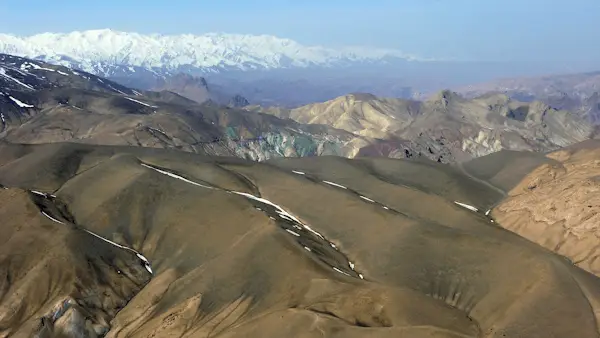
Minerals and rare earth metals in Afghanistan were estimated to be worth between $1 trillion and $3 trillion in 2020, according to a news magazine The Diplomat, citing Ahmad Shah Katawazai, a former diplomat at the Afghan Embassy in Washington, D.C.
Shamaila Khan, director of emerging market debt at AllianceBernstein, said the Taliban insurgents have emerged with resources that are a “very dangerous proposition for the world,” with minerals in Afghanistan that “can be exploited.” The international community should put pressure on China if it seeks to ally itself with the Taliban, Khan added.
“It should be an international initiative to make sure that if any country is agreeing to exploit its minerals on behalf of the Taliban, to only do it under strict humanitarian conditions where human rights, and rights for women are preserved in the situation,” said Khan. The Taliban’s harsh interpretation of Islam has meant that women’s rights were curtailed, before the U.S. toppled its regime in 2001. Communist China welcomed the Taliban a day after the Taliban militants took over the country’s rare earth minerals.
Afghanistan has rare earth minerals such as lanthanum, cerium, neodymium, and veins of aluminum, gold, silver, zinc, mercury, and lithium, according to Katawazai. Rare earth minerals are used in everything from electronics to electric vehicles, and satellites and aircraft.
Only hours after the Taliban overran Afghanistan, a foreign ministry spokeswoman said Beijing was ready for “friendly cooperation with Afghanistan…. On the basis of fully respecting the sovereignty of Afghanistan and the will of all factions in the country, China has maintained contact and communication with the Afghan Taliban and played a constructive role in promoting the political settlement of the Afghan issue,” said spokeswoman Hua Chunying. According to Hua, the Taliban said “on multiple occasions” that it “looks forward to China’s participation in Afghanistan’s reconstruction and development. We are ready to continue to develop good-neighborliness and friendly cooperation with Afghanistan and play a constructive role in Afghanistan’s peace and reconstruction,” Hua said.
In late July, before the Taliban’s latest blitz across Afghanistan, China’s Foreign Minister Wang Yi met with a delegation led by the head of the Afghan Taliban political committee Mullah Abdul Ghani Baradar in Tianjin.
China’s state-run Global Times reported that China can “contribute to post-war reconstruction and development, pushing forward projects under the China-proposed Belt and Road Initiative.” The BRI is a mammoth infrastructure investment plan to build rail, road, sea and other routes stretching from China to Central Asia, Africa and Europe.
China dominates the rare earth minerals market globally. About 35% of rare earth minerals global reserves are in China, the single largest supply in the world, according to the United States Geological Survey. The country is also a mining machine, producing 120,000 metric tons or 70% of total rare earth minerals in 2018, compared to the U.S. which mined 15,000 metric tons of rare earths the same year, it said. Rare earth minerals mining could change the U.S.’s dependence on China. U.S. reserves also pale in comparison to China. The U.S. has a total of 1.4 million metric tons of reserves, versus 44 million metric tons of reserves in China.
China used rare earth minerals as a threat during its trade war with the U.S. in 2019, when Beijing threatened to cut off supplies to the U.S. The U.S. was heavily dependent on China for rare earth minerals in 2019, when the Asian country was exporting 80% of U.S. needs, according to the U.S. Geological Survey.
Share this:
- Share on Facebook (Opens in new window) Facebook
- Share on X (Opens in new window) X
- Share on LinkedIn (Opens in new window) LinkedIn
- More
- Share on WhatsApp (Opens in new window) WhatsApp
- Share on Telegram (Opens in new window) Telegram
- Share on Reddit (Opens in new window) Reddit
- Email a link to a friend (Opens in new window) Email
- Share on Pinterest (Opens in new window) Pinterest
- Share on Tumblr (Opens in new window) Tumblr
- Print (Opens in new window) Print