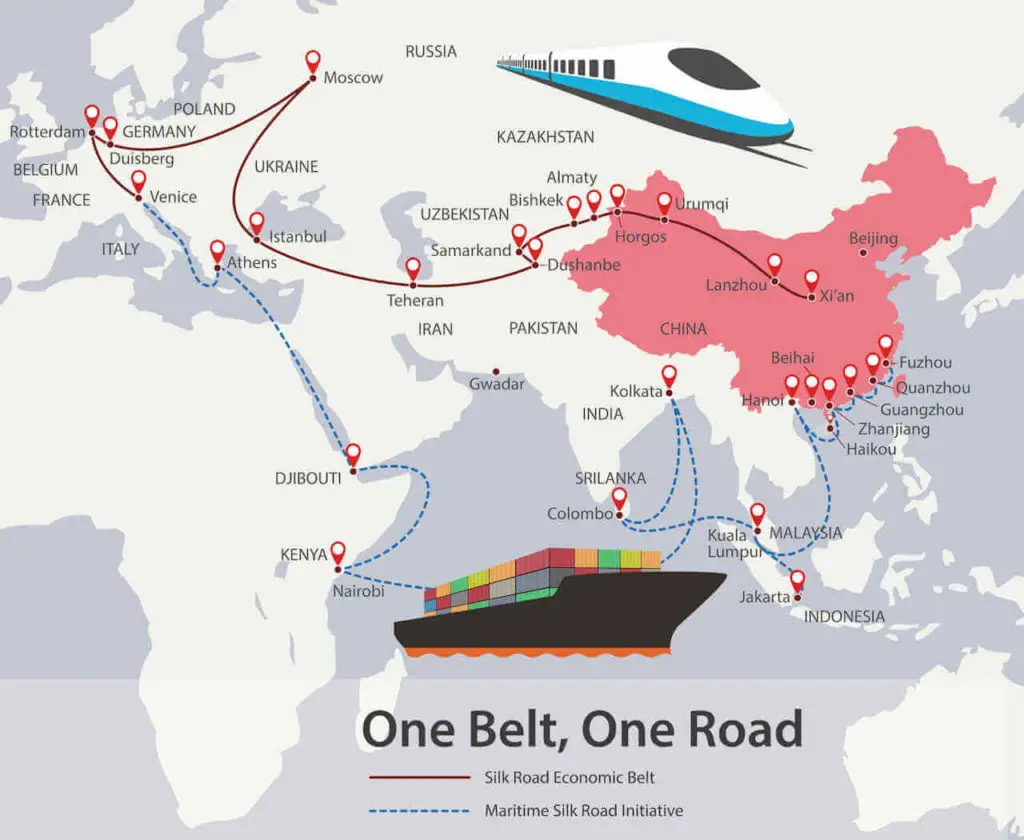
For more than a millennium (roughly 206 BC to 907 AD), globalism was represented by two extensive road networks: the Roman Road and the Silk Road. The two road networks met along the Eurasia boundary, with Europe gaining access to innovations like silk, gunpowder, and paper while China received horses, precious metals, and fabrics from wool and cotton in return. The trade routes were the ancient equivalent of globalism, heavily influencing the development of cultures at either end of the route. As we have learned recently, disease can be traded as easily as goods, and plagues like the Black Death ended the flow of merchants.
In Fall 2013, Chinese President Xi Jinping presented his vision for “a project of the century,” a recreation of the ancient trade networks consisting of a new arrangement of railways, energy pipelines, highways, and ports. In essence, the construction of a Silk Road 2.0. His vision encompasses three projects, an overland Silk Road Economic Belt, an ocean-going 21st Century Maritime Silk Road, and a Digital Silk Road. Together, these projects are now referred to as the Belt and Road Initiative.
A total of $1.2 trillion in funding by 2027 has been committed to the BRI project so that China can expand its strategic influence from the Pacific to the Atlantic, with the goal of dominating the Asian and African continents. China would expand its international influence by developing infrastructure across nations that lacked the funds and technology to do it independently.
According to the Belt and Road Forum website, where China keeps the world updated on its progress, $750 billion has been invested so far, and the program has attracted 149 nations and 32 international organizations, covering 70% of the world’s population, including solid American allies such as South Korea, Israel, Poland, and Italy. The more than 2,600 announced projects include major structures such as the Maputo-Katembe bridge in Mozambique, the Addis Ababa-Dijbouti Railway in Ethiopia, Baku International Sea Trade (Azerbaijan) and Piraeus (Greece) Ports, and the Uzbekistan-Tajikistan-China Highway.
As a result of its four-decade-long One Child policy and its unbalanced international trade, China has an over-abundance of two things: cash and single men. The 46% national savings rate in China exceeds the global average in Government, Corporate, and Personal Savings. Additionally, as the nation habitually runs a trade surplus, the accumulating incoming currency, along with the life savings of 1.4 billion people, reflects significant funds which need to find an investment home, one not readily available domestically. Those savings rates are an unintended consequence of the One Child policy as those smaller families didn’t incur the costs of additional children and the associated weddings and education.
Due to the preference for sons over daughters, China has become a nation that currently has nearly 35 million single men for which there are no brides. Additionally, career-oriented educated Chinese women are in no hurry to get married so nearly 1 in 4 marriage-eligible men are unable to find a suitable partner. These policies lead to China having the money and men to send across the globe in support of its strategic initiatives.
The design of the BRI process intentionally advantages Chinese companies wishing to bid on various aspects of the projects. While the receiving nations can benefit from the investments, the largest beneficiaries are the Chinese companies, who can keep their order books full and workforce employed while not worrying about domestic economic problems. According to documents from the World Bank Group, more than 60% of the BRI-funded projects have gone to Chinese firms, as opposed to only 30% to non-Chinese institutions. While international procurement standards exist to enhance international trade, the majority of the underdeveloped nations participating in BRI are not signatories nor use those standards in their project processes. This, along with a lack of transparency, leaves many with the view that these construction bids may actually be rigged, having a predetermined outcome. Much of the loan funds never leave China, instead, the loans are converted into contracts for needed Chinese goods, sometimes at prices in excess of the going rate.
As China builds its Digital Silk Road across Central and South Asia, these nations may have to learn the very lessons America had to learn through the scandals of Huawei, ZTE, and TikTok, the security of any system is only as secure as the trustworthiness of the companies providing the hardware.
China’s vision of international aid comes with heavy costs and strings, especially through BRI. While America’s aid is most commonly in the form of grants with no expectation of repayment, assistance through BRI comes in the form of low-interest, long-term loans. Loans with conditions that favor specific solutions, technologies, and companies.
The glorious, altruistic promises of the Belt and Road Initiative have often come up short. Many projects sit abandoned in half-finished disrepair, while others never materialize. Recently, Malaysia, Kazakhstan, and Bolivia have all mothballed projects with concerns over debt sustainability. The completed projects tend to suffer from environmental destruction, wasteful spending, and debt levels that leave doubt that they can ever be repaid.
Forty-three nations, such as Pakistan, Sri Lanka, and Malaysia, already suffer from credit ratings typically classified as “junk” and have little prospect of repaying the massive loans. As a result, some countries find settling on concessions to be easier than finding the cash for the loan payments, for example, Sri Lanka gave China Merchant Port Holdings, a company 70% owned by China’s national government, a 99-year lease of its Hambantota Port. To date, as much as 25% of China’s overseas lending has required renegotiating over $100 billion in unsustainable loans.
Too often, countries find that while BRI constructs the project centerpieces, the nation subsequently finds itself ill-equipped to construct the mundane. So while BRI may complete a project, the host of supporting structures are often lacking and lead to the recipient nations incurring even more debt. Still, while many nations have expressed doubts and second thoughts regarding the Belt and Road Initiative, they return to the program expressing the idea that they “don’t have many options better” than what China was offering.
There is a fundamental philosophical difference in how the two superpowers, America and China, approach the question of aid to the international community. America’s non-military aid is managed by the United States Agency for International Development, whose mission statement declares that they “promote and demonstrate democratic values abroad and advance a free, peaceful and prosperous world.” This is accomplished through “investments that save lives, reduce poverty, strengthen democratic governance, and help people emerge from humanitarian crises and progress beyond assistance.” This American mission leads to investment in projects with a local focus that benefits individuals: wide-ranging projects to improve agricultural production, provide clean water, improve local education, and protect human rights. America’s goal is to fund programs that, if successful, will allow the recipients to continue on their own. This stands in stark contrast to the aims of the Belt and Road Initiative, which is to provide government-to-government funding to build projects on a massive scale where China’s assistance will be needed for years to come.
The Belt and Road Initiative has transformational potential, with the ability to change the power dynamic between China, its neighbors, and the international community. With such significant sums invested, the idea that our current world built on western “international standards” could someday become a world constructed along the lines of “China Standards 2035” is not unthinkable.
Share this:
- Share on Facebook (Opens in new window) Facebook
- Share on X (Opens in new window) X
- Share on LinkedIn (Opens in new window) LinkedIn
- More
- Share on WhatsApp (Opens in new window) WhatsApp
- Share on Telegram (Opens in new window) Telegram
- Share on Reddit (Opens in new window) Reddit
- Email a link to a friend (Opens in new window) Email
- Share on Pinterest (Opens in new window) Pinterest
- Share on Tumblr (Opens in new window) Tumblr
- Print (Opens in new window) Print