When I was younger, I believed a meaningful life was one I’d be proud to share in old age, sitting frail but content at a family gathering, surrounded by children and grandchildren.
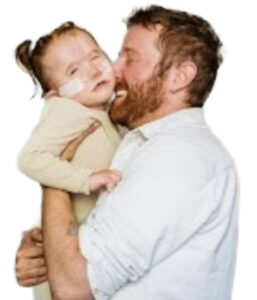
Robin Koczerginski and daughter Bree
I had a recipe for a meaningful life: a heavy dose of impact, a dash of adventure, generous helpings of love and relationship, all baked in a base of longevity.
But what if human value isn’t something we build over time, but something that exists in a single moment? What if it isn’t earned, but inherent?
When my daughter Bree burst into the world like a meteor crashing into my life, everything I thought I knew about meaning was shaken. Bree has a rare genetic condition called Trisomy 13, or Patau Syndrome. There’s no cure or treatment. It isn’t a disease; it’s an imprint, a fundamental part of who she is. She has an extra 13th chromosome tucked into every cell in her body.
The impact of this extra chromosome varies, but in most cases, it brings profound cognitive and physical disabilities. We found out about Bree’s diagnosis during pregnancy. We were told she might not make it to birth and if she did, her life expectancy would be measured in weeks.
How do you measure the worth and meaning of a life that might be short and full of medical complexity?
In the very early days of her life, when we lived in the NICU at Mount Sinai Hospital, when every beep of a monitor sent waves of panic through my body, when her fragility felt too much to bear, I believed it was my duty as her father to impose value on her life.
While Bree pushed forward, embracing each new challenge with a quiet resilience, the idea of her death loomed over me. I put immense pressure on myself to solve the question of what her life meant, because I believed I would one day have to justify it. I was already silently writing her eulogy.
I thought I had to be the vessel for her worth. I vowed to become a better person when she was gone. I imagined starting a fundraiser, launching a charity, so the money raised in her name could “do good” in the world. Because if death took her as an infant, I thought meaning had to be made, not simply felt. But Bree didn’t die.
There were minor medical procedures and lots of trials to find the right medications to support her. There were new routines developed. There was a blossoming life with Bree.
She kept surviving and exceeding the minimal expectations placed on her. She reshaped the expectations I had for her life.
What changes in how we value her life if she wasn’t just a brief shooting star in our life? Not a tragedy I had to redeem, but a full participant in our family’s core?
As Bree grew older, and I worked hard to understand the anticipatory grief I was feeling, I began to appreciate Bree for who she was, not what I, or society, expected her to be. She is almost four-years-old now. She has vision loss, low-muscle tone, is on a continuous G-tube feed, is medicated to control her seizures that come out as short myoclonic jerks, requires constant low-flow oxygen, and is monitored 24 hours a day for her safety. She is and will likely always be non-verbal and never be able to be independent in any way.
Yet, Bree has carved out a beautiful existence, one wrapped in love, insulated from the noise and stress and existential panic the rest of us often live with. She experiences joy through the songs she likes, the textures of her toys in her mouth, the motion of being carried by her mother, the brightness of the sun gracing her face, and the sounds of her big sister’s high-pitched voice. She cannot understand the literal meaning of the words “I love you,” but she feels the energy behind those words as she displays her love for the world.
Her progress and her potential are not her path towards value. By simply existing and being loved, her life holds complex and very real layers of meaning. She has taught me that presence, connection, and a soft harmonization with the world make a meaningful life.
Bree changed me fundamentally. She expanded my capacity to love. She opened me to fatherhood. She slowed me down and sharpened my focus. She introduced me to a community I would never have found otherwise. Bree has and will likely never say a word, and still she shifts the ground beneath me.
Bree taught me that meaning can live in the intimate and the invisible. In the way I approach other families with disabled children. In the way I’ve started writing, to stay close to her.
The question is not “Did this person leave a legacy?” But “Were we changed by loving them?”
If the answer is yes, then something important happened. Even if no one else sees it. Even if it didn’t last long.