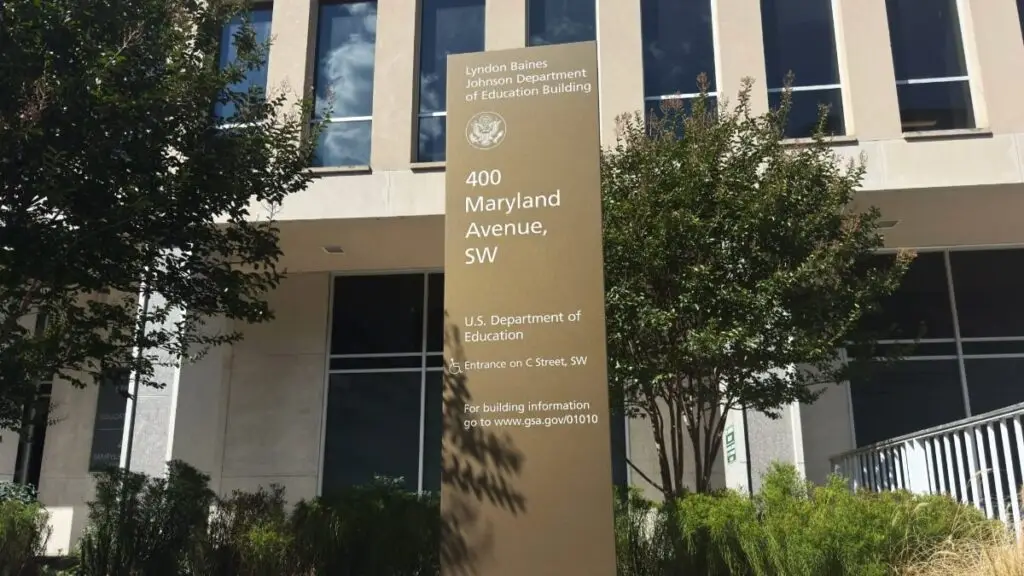
On Tuesday, the Department of Education announced new interagency partnerships that will weaken the federal government’s grip on our nation’s school system. One of the Trump administration’s top priorities has been to shut the doors of the failing Department of Education where policies have increasingly become political rather than practical. The newest actions are another step toward the goal of allowing parents and states to have a larger role in directing their children’s education.
Our founder, Phyllis Schlafly, called for the abolition of the Department of Education in 1995, writing, “Contrary to the gloom-and-doom fearmongering of the education lobby, U.S. public schools will not collapse if the Department of Education is abolished. Public schools flourished before there was any Department of Education (and academic standards were much higher), and public schools will continue to exist if the Department is abolished. . . ., The U.S. Constitution doesn’t mention education, and there is no authority in the Constitution for the Federal Government to meddle in local schools. Education is not a proper federal function. If the Federal Government has no constitutional authority to ban guns from schools, then it follows a fortiori that the Federal Government has no authority to impose curricular requirements or hand out funds according to the whims and the politics of federal officials.”
The idea of federal involvement in education began during the Cold War. In 1958, President Dwight D. Eisenhower signed the National Defense Education Act (NDEA) into law. The NDEA allocated $1 billion to schools to fund math, science, and foreign language instruction. With the Soviet Union’s success in launching Sputnik into space, Eisenhower saw it as an imperative investment so that a new generation of Americans could advance technology and space exploration.
As with any federal government program, the federal involvement in education continued to grow with subsequent administrations. During President Lyndon B. Johnson’s term, he instituted the “War on Poverty.” One of its key initiatives was increasing the investment in education. He created Project Head Start for low-income preschoolers, grant programs for school facilities, scholarships for low-income college students, and the Teacher Corps to send seasoned teachers into impoverished areas. Perhaps the greatest expansion of federal intervention into education was the Elementary and Secondary Education Act (ESEA) of 1965 which directed $1 billion to every facet of education, such as books, libraries, nutrition, and teacher training. It was designed “to close the skill gap in reading, writing and mathematics between children from low-income households who attend urban or rural school systems and children from the middle-class who attend suburban school systems.” However, the ESEA failed and the gap between rich and poor students continued to grow.
Then, in 1980, President Jimmy Carter established the Department of Education (DOE) which was a campaign promise to the National Education Association – the teachers’ union. President Ronald Regan denounced this move but was unable to abolish the agency during his presidency.
By the end of President Joe Biden’s term, the DOE housed 4,400 employees and managed a $29 billion budget.
In 1998, the House Committee on Education and the Workforce released a report titled Education at a Crossroads: What Works and What’s Wasted Today. They found that 40% of fourth graders did not read at a basic level, half of students in urban areas failed to graduate on time or at all, and American students were worse off academically the longer they stayed in school compared to other countries. In many areas, federal involvement meant no change or worse outcomes for students than before the Department came into existence. Then-President Bill Clinton’s response was to implement even stricter national academic standards than President George H.W. Bush’s Goals 2000 program, as well as put internet in classrooms. President George W. Bush famously expanded ESEA through the No Child Left Behind law, which ultimately led teachers to teach only the topics on the national standardized tests so they would not be punished for low test scores.
Despite multiple ESEA reauthorizations, allocating more money toward schools, the adoption of national standards, and the creation of more programs aimed at improving test scores, nothing has changed. Test scores continue to trend downwards despite the removal of penalties for wrong answers! Under the Obama and Biden administrations, they focused more on pushing radical sexual orientation and gender identity lessons, DEI (diversity, equity and inclusion) policies, putting boys in girls’ restrooms and allowing biological males to compete in women’s sports rather than protecting the developing minds of adolescents.
President Donald Trump took another view. He looked at the years of mismanagement of education and listened to a novel idea from conservatives: return education to the states. In March of last year, he signed an executive order to empower parents by closing the DOE. Since then, Education Secretary Linda McMahon has worked to scale back the reach of the DOE in property, employment, and programs. So far, she has reduced the size of the DOE’s staff by half, begun the process of moving the department to a smaller building that would better fit its new size, and redirected $3 billion in education grants that did not align with the department’s mission.
On Wednesday, the DOE announced four new interagency partnerships to further the mission of dismantling the federal behemoth. This came on the heels of ten prior partnerships including the sharing of workforce programs with the Department of Labor and student loans with the Department of the Treasury. The first new partnership is with the Department of Health and Human Services (HHS) on special education programming. This would include programs such as Head Start, early intervention, and vocational rehabilitation. HHS already serves individuals with disabilities through programs such as Centers for Independent Living, the Children’s Health Insurance Program (CHIP), and some aspects of the Head Start program.
Secretary McMahon explained in an op-ed to Fox News that in several listening sessions, parents lamented the excessive red tape and hoops that parents must jump through just to get basic services for their children. This partnership with HHS is a commonsense approach to connecting people with disabilities with services they will need throughout their entire life, instead of forcing them to bounce around from agency to agency. HHS Secretary Robert F. Kennedy, Jr. stated:
Through this partnership, HHS and the Department of Education will cut bureaucratic barriers, better align federal resources, and deliver more effective support for individuals with disabilities and their families. Together, we will improve education and employment outcomes, uphold the rights of individuals with disabilities, and help every child reach their full potential.
The next three interagency partnerships will be with the Department of Justice (DOJ). DOE will partner with DOJ on matters regarding the Office of Civil Rights, student privacy protection, and training for school districts and boards. The Student Privacy Protection Partnership will “ensure that state and local education agencies and institutions of higher education protect student privacy and parents’ access to information about their children’s education records and curricula, properly secure information collected from students by education agencies and institutions, and safeguard parents’ rights to determine whether their children participate in certain school-administered surveys.
Eagle Forum has long been a leader on the Protection of Pupil Rights Amendment (PPRA). The PPRA was designed to forbid schools, without prior written parental consent, from imposing psychological or psychiatric tests or treatment on children, or to invade their privacy by making them answer nosy questions about sex, attitudes, and family matters that are embarrassing or none of the school’s business. The original PPRA was passed by Congress in 1978, but it was ignored until 1984, when the Department of Education finally issued regulations in response to public demand. Eagle Forum published Child Abuse in the Classroom, a collection of excerpts from the seven hearings that were held that year before the regulations were issued. Thomas Sowell said of the book, “It should be required reading for every parent.”
Eagle Forum has attended meetings and calls this week discussing these new interagency partnerships. As you may know, the complete shuttering of the Department of Education cannot be done by the Administration alone but will take an act of Congress. In the meantime, the Trump administration is working hard to dismantle much of its current functions and hand over the power of education back to the states. As President Reagan stated in 1980, just months before his election, “The office of the Presidency must ensure that the awesome power of government respects the rights of parents and the integrity of the family. If a President can propose taxes, regulations, controls and embargoes, he can propose, as well, ways to keep big government out of the school and the neighborhood and above all — the home.”
Join us in Nashville for Eagle Council 54, where we will hear more about efforts to empower parents and protect student privacy rights from Sarah Parshall Perry, the Vice President and Legal Fellow at Defending Education and a former Senior Counsel at the U.S. Department of Education’s Office for Civil Rights. Eagle Council 54 will take place September 24-26 and will feature Eric Metaxas, Katy Faust, a trip to Andrew Jackson’s home, The Hermitage, and much more. Register today for this exciting conference HERE.
This week, we welcomed our summer intern as well. Layna DeFeo is a rising junior in high school and will be joining us over the summer to get an up-close and personal look at just what it means to be a grassroots lobbyist! Along with shadowing our Executive Director and President in Washington, D.C., she will be contributing to our Capitol Hill Reports every week. See below for her account of her first week on the job.
Welcome to my Eaglet’s Perch:
My name is Layna DeFeo, I’m a rising junior at an all-girls Catholic school outside of Washington, D.C., and I’m grateful to be Eagle Forum’s intern this summer. I was asked to share some information about myself and help people know who I am. The question is not only who am I but whose I am, as theologian John Piper points out. The outlook of living as a servant of God encourages me to desire His Kingdom on earth and to see His principles laid out in our nation’s policies. This leads me to Eagle Forum, a group of godly women who understand the necessity of God’s rightly ordered design in both daily life and in the order of a country.
This past week, I dived into the internship by going to Capitol Hill meetings with Mrs. Walter and Mrs. Ullman. Monday, we attended the Republican Study Committee at the Rayburn House Office Building. On Tuesday, Mrs. Walter and I attended the Conservative Working Group at the Hart Senate Office Building. Both meetings from Monday and Tuesday sparked discussions of Reconciliation bills; what they are, the first reconciliation bill, “One Big Beautiful Bill Act”, the movement of 2.0, and the need for a third. In the evening, we watched the painstaking process of a live taping of the Freedom 250 Presidential Awards Finals at the Kennedy Center. [The finals of this high school civics competition will be broadcast Tuesday, June 30, (8:00-9:30 PM ET/PT) on the CBS Television Network. It will be available to stream the next day on Paramount+.]
Wednesday morning, we met with the Freedom 250 Civic Education Coalition (managed by AFPI) at a near-empty Department of Education, where we heard from Secretary McMahon herself and other Department members on their recent efforts to cut off money, drain practices, and return control of education policy to the States. Finally, on Thursday, I had the opportunity to learn the process of selecting Supreme Court Justices and potential replacements for when the time arises.
This last week was a week of firsts. I have grown up surrounded by these buildings, people, and lifestyles, yet I have now entered into the culture myself. For the first time, I have navigated the Metro alone, attended meetings in both Senate and House buildings, and have met many like-minded men and women. I am excited to see where else this internship takes me this summer!
Share this:
- Share on Facebook (Opens in new window) Facebook
- Share on X (Opens in new window) X
- Share on LinkedIn (Opens in new window) LinkedIn
- More
- Share on WhatsApp (Opens in new window) WhatsApp
- Share on Telegram (Opens in new window) Telegram
- Share on Reddit (Opens in new window) Reddit
- Email a link to a friend (Opens in new window) Email
- Share on Pinterest (Opens in new window) Pinterest
- Share on Tumblr (Opens in new window) Tumblr
- Print (Opens in new window) Print