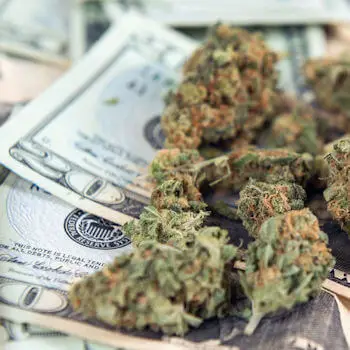
 The SAFE Banking Act, H.R. 1595/S. 1200, allows marijuana businesses access to the federal banking system. The bill undermines federal law and allows for legal money laundering in which banks receive illegally obtained funds. Today, marijuana is more potent[1] than it was 20-plus years ago and comes in many forms that all contain differing levels of delta-9-tetrahydrocannabinol (THC), the chemical giving the drug user euphoria and intoxication, and cannabidiol (CBD). Marijuana use not only leads to physical dependency, addiction, agitation, paranoia, but it also harms developing brains.[2] The country is in the midst of a public health crisis related to vaping products with varying levels of THC[3], and this legislation will further encourage this crisis. H.R. 1595 passed the House of Representatives on September 25, 2019 and awaits action in the Senate.
Specifically, the SAFE Banking Act:
- Prevents federal banking regulators from punishing financial institutions that finance marijuana businesses that are legal under state or local laws.
- Encourages Wall Street investment into the multibillion-dollar marijuana industry that will mimic big-tobacco’s expansion and influence[4].
- Further encourages marijuana businesses to create products, like gummies and ice cream, that are targeted at vulnerable populations: pregnant women, children, and adolescents. Despite making health claims about these products, the industry is not regulated by the FDA and there is no way to monitor how much THC or other products are actually in the product being consumed[5].
- Acts as a back-door method to marijuana’s federal legalization. House Democrats made it clear that the SAFE Banking Act would ultimately lead to the drug’s federal legalization[6].
- Includes no protections prohibiting drug traffickers from accessing the banking system, like what has happened in Canada[7]. President Trump enacted a nation-wide call to action to combat the opioid epidemic[8] and by financing traffickers, this legislation undermines that effort.
[1] Alex Berenson, “Marijuana, Mental Illness, and Violence,” Eagleforum.org, accessed October 14, 2019, https://eagleforum.org/publications/efr/mar19/marijuana-mental-illness-and-violence.html.
[2] U.S. Department of Health and Human Services, Surgeon General Adams Releases Advisory on Marijuana’s Damaging Effects on the Brain, August 29, 2019, Press Conference, https://www.youtube.com/watch?v=pP7kXJnX9z8.
[3] U.S. Food and Drug Administration, Statement on consumer warning to stop using THC vaping products amid ongoing investigation into lung illnesses, October 4, 2019, Press Release, https://www.fda.gov/news-events/press-announcements/statement-consumer-warning-stop-using-thc-vaping-products-amid-ongoing-investigation-lung-illnesses.
[4] David Gelles, “When the Makers of Marlboro and Corona Get Into Marijuana,” New York Times, December 12, 2018, https://www.nytimes.com/2018/12/12/business/cannabis-business-altria-canopy-constellation-cronos.html.
[5] Sarah Owermohle, “Flood of products containing marijuana extract puts FDA in a bind,” Politico, March 26, 2019, https://www.politico.com/story/2019/03/26/marijuana-fda-food-extracts-1290835.
[6] Majority Leader Steny Hoyer, Hoyer Statement on the SAFE Banking Act, September 25, 2019, Press Release, https://www.majorityleader.gov/content/hoyer-statement-safe-banking-act.
[7] Marie-Maude Denis, “Licensed cannabis growers have ties to organized crime, Enquête investigation finds,” Canadian Broadcasting Corporation, November 1, 2018, https://www.cbc.ca/news/canada/montreal/cannabis-health-canada-enquete-investigation-1.4887997.
[8] “Ending Americas Opioid Crisis,” The White House, accessed October 14, 2019, https://www.whitehouse.gov/opioids/.